Category: Market Insights

Evidence-based insights and real estate market context in Miami-Dade.

  • Florida Amendment 2 Passed: What It Means for Miami-Dade Property Taxes

    Florida Amendment 2 Passed: What It Means for Miami-Dade Property Taxes

    Last week, Florida voters made two decisions about property taxes, and both affect owners here in Miami-Dade. Amendment 2 passed, keeping a 10 percent annual cap on assessment increases for non-homestead property. Amendment 1, which would have added a new homestead exemption, did not pass. Here is what each result means, and what does and does not change for you.

    Amendment 2: the 10 percent cap stays

    In 2008, Florida voters approved a limit on how much the assessed value of non-homestead property can rise each year: no more than 10 percent. That cap covers property such as rental homes, second homes, vacant land, and commercial property. It does not apply to school district taxes. As written in 2008, the cap was set to expire on January 1, 2019.

    Amendment 2 asked voters whether to make that cap permanent. According to the Florida Division of Elections, about 66 percent voted yes, above the 60 percent needed to amend the constitution. The cap will now continue past January 1.

    Who this affects: If you own a condo you rent out, a second home, or a property you have not homesteaded, the cap limits how fast its assessed value can rise. In a market where values have been climbing, as they have in much of Miami-Dade, that limit can make a meaningful difference in taxes over time.

    What it does not do: The cap does not freeze your taxes. Tax rates are set separately each year, and the cap does not limit school taxes. When a non-homestead property sells, its assessed value can reset to market value, so a buyer should not assume the seller’s tax bill will carry over.

    Amendment 1: no new homestead exemption

    Amendment 1 would have added a third homestead exemption, excluding the part of a home’s assessed value between $100,000 and $125,000 from non-school property taxes. Homes assessed at $100,000 or less would not have benefited.

    It received about 58 percent of the vote, short of the 60 percent required. So nothing changes for homestead owners. You still have the existing exemption of up to $50,000, and your assessed value can still rise by no more than 3 percent a year or the change in the Consumer Price Index, whichever is lower. For 2018, that cap was 2.1 percent.

    Your tax bill and the November discount

    Under Florida law, property taxes become due on November 1, and the Property Appraiser said in August that 2018 tax bills would arrive in November. Paying in November earns a 4 percent discount. The discount drops to 3 percent in December, 2 percent in January, and 1 percent in February. If your mortgage company pays your taxes through escrow, ask when it plans to pay and check your escrow statement afterward.

    If you have a homestead exemption, look at your bill to confirm it is applied. If you bought a home this year and moved in by January 1, 2019, you can apply for homestead for 2019. The deadline will be March 1.

    What this means if you are buying

    • For a home you will live in, plan for homestead. Your taxes after the purchase will be based on your own assessed value and exemptions, not the seller’s.
    • For an investment or second home, Amendment 2 means the 10 percent cap will continue to limit increases in assessed value after the first reset. That makes long-term tax planning a little more predictable.
    • Rates matter as much as taxes. Freddie Mac’s average 30-year fixed rate reached 4.94 percent for the week ending November 8, the highest weekly average since early 2011. Look at the full monthly payment, including taxes and insurance, before you set your budget.

    What this means if you own non-homestead property

    If you own rental or second-home property, the outcome of Amendment 2 is probably good news for your long-term costs. It is still a good time to look at your 2018 assessment and your tax bill. If you believe your value is out of line, the Property Appraiser’s office can explain how it was set and what your options are for next year.

    A steady view

    Ballot results can feel dramatic, but this year’s changes are mostly about keeping things as they are: the existing cap continues, and the existing homestead exemption stays the same. The practical steps are simple. Pay your bill on time to keep the discount, confirm your exemptions, and plan a purchase with your own numbers in mind.

    If you would like to talk through how these results affect a home you own or one you are thinking of buying, I am happy to help, calmly and without pressure.

    You can reach me at (305) 409-2815 or mflores@primefloridahome.com.

    Warmly,
    Mariela

    Restored to our archive in 2026, reflecting the market as of November 2018

  • Your 2018 TRIM Notice: What Miami-Dade Property Values Are Telling Us, City by City

    Your 2018 TRIM Notice: What Miami-Dade Property Values Are Telling Us, City by City

    If you own property in Miami-Dade, a notice from the Property Appraiser should be in your mailbox this week. The Notice of Proposed Property Taxes, which most people call the TRIM notice, was mailed on Friday, August 24. It is not a bill, but it is the best chance you have all year to understand, and if needed question, the value behind your taxes. It also gives us a useful look at how values are moving across the county’s cities and neighborhoods.

    What is on your TRIM notice

    According to the Property Appraiser, each notice shows:

    • Your property’s assessed value as of January 1, 2018
    • Any exemptions applied to it, such as homestead
    • Your proposed taxes, based on the rates each taxing authority has proposed
    • The dates, times, and places of each authority’s budget hearings

    The notice is also available online at the Property Appraiser’s website. Your actual tax bill will arrive in November.

    How values moved across Miami-Dade

    On June 28, the Property Appraiser released the 2018 preliminary taxable value for the whole county: about $290.1 billion, up 6.5 percent from 2017. More than $5.6 billion of that came from new construction.

    Some municipalities grew by double digits, mostly because of new construction:

    • Surfside: 43.5 percent
    • Bay Harbor Islands: 17.8 percent
    • West Miami: 15.7 percent
    • North Miami Beach: 15.6 percent
    • Florida City: 13.4 percent
    • Biscayne Park: 11.5 percent
    • Opa-locka: 10.4 percent
    • Hialeah Gardens: 10.3 percent

    In its June 1 estimate, the Property Appraiser described the same split I see in the sales data. A relative shortage of mid-range single-family homes has pushed those values up, while an oversupply of condominiums has put downward pressure on condo values. The office also noted market corrections in some condominiums and higher-value single-family homes, naming Key Biscayne and Sunny Isles Beach as examples. In Bal Harbour, Surfside, and Aventura, new construction helped offset lower values on some existing properties.

    These are citywide figures, and your street may not follow the citywide trend. A big new building can lift a city’s total while values on existing homes stay flat. That is why the number that matters most is the one on your own notice.

    Why your assessed value may differ from your market value

    If your home has a homestead exemption, its assessed value can rise by no more than 3 percent a year or the change in the Consumer Price Index, whichever is lower. For 2018 that cap is 2.1 percent. So even if your neighborhood’s market values rose 6 or 8 percent, your assessed value probably rose much less.

    For non-homestead property, such as a rental home, a second home, or commercial property, the cap is 10 percent a year, and it does not apply to school taxes. That 10 percent cap is scheduled to expire on January 1, 2019, unless voters make it permanent. That question is on the November ballot as Amendment 2, and I will write more about it after the election.

    If you think your value is too high

    First, look up your own property and recent nearby sales on the Property Appraiser’s website. If you still believe your property is over-assessed:

    • Ask for an informal review. The Property Appraiser included an Informal Assessment Review Form with the notice. This process can resolve a concern faster than a formal appeal.
    • Attend an outreach event. Staff will be available at 5:30 p.m. on August 30 at the South Dade Regional Library in Cutler Bay, September 5 at the Milander Center in Hialeah, September 13 at the West Dade Regional Library, and September 18 at the North Dade Regional Library in Miami Gardens. Bring comparable sales, an appraisal, photos, or insurance claim paperwork.
    • Know the formal deadline. A petition to the Value Adjustment Board must be filed within 25 days after the TRIM notice is mailed. The exact date is printed on your notice.
    • Missed the homestead deadline? If you qualified for homestead on January 1 but did not file by March 1, you may still be able to file a late application. The deadline for that is also printed on your TRIM notice, in mid-September.

    Proposed rates are not final yet

    The tax amounts on your notice use proposed rates. Each taxing authority holds public budget hearings before its rates are final, and the dates, times, and places are on your notice. If you want a say in the rates, those hearings are the place.

    Let’s read it together

    If your TRIM notice raised questions, or you are wondering how values in your city compare with what homes are actually selling for, send me a note. I am happy to look at it with you, calmly and with no pressure.

    You can reach me at (305) 409-2815 or mflores@primefloridahome.com.

    Warmly,
    Mariela

    Restored to our archive in 2026, reflecting the market as of August 2018

  • Miami-Dade’s Housing Market at Midyear 2018: What June’s Numbers Show

    Miami-Dade’s Housing Market at Midyear 2018: What June’s Numbers Show

    We are halfway through 2018, and the MIAMI Association of REALTORS® has released its June report. I like to read these numbers slowly, because a single headline rarely tells the whole story. This month is a good example: sales dipped slightly, prices rose, and the picture changes a great deal depending on the price range you are looking at.

    Sales: a small dip, for a clear reason

    Single-family home sales in Miami-Dade were nearly flat in June, down 0.8 percent from a year earlier, from 1,346 to 1,335. Existing condo sales fell 5.0 percent, from 1,323 to 1,257, after rising in both April and May.

    The Association pointed to a lack of inventory in lower and middle price ranges as the reason sales slipped. In other words, buyers are out there, but there are not enough homes in the price ranges many of them are shopping.

    At the top of the market it was a different story. Sales of $1 million and up rose 21.5 percent, from 181 to 220, with luxury condo sales up 28.0 percent.

    Prices: still climbing, faster for houses than condos

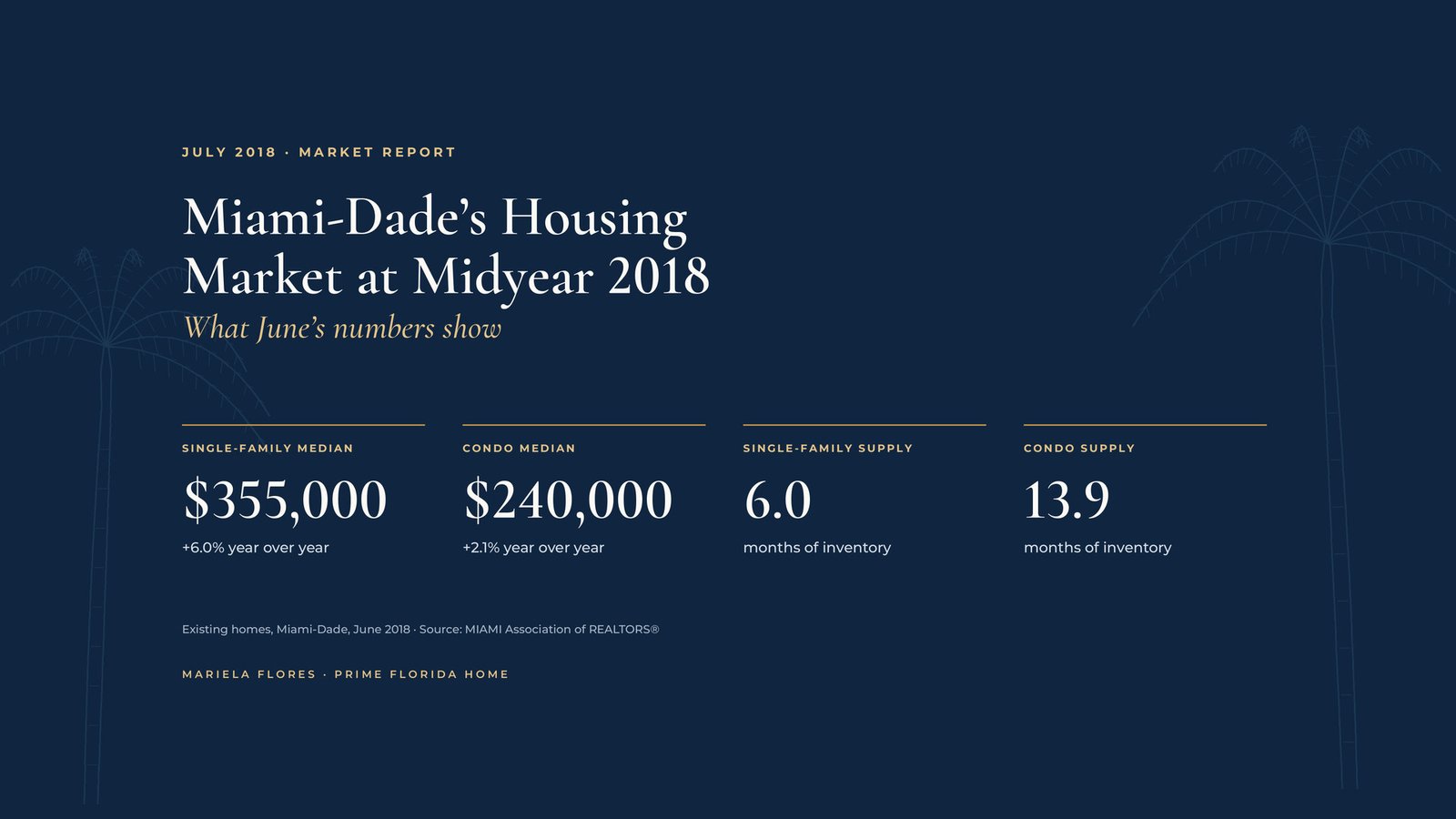
    The median price of a single-family home rose 6.0 percent, from $335,000 to $355,000. The Association counts this as the 78th consecutive month of year-over-year gains, a streak of more than six and a half years.

    The median existing condo price rose 2.1 percent, from $235,000 to $240,000.

    Sellers of single-family homes received a median of 95.7 percent of their original list price. That tells me well-priced homes are still selling close to asking, but most buyers are not paying more than list.

    Two markets, split by price

    This is the part of the report I most want you to see. Overall, single-family homes had 6.0 months of supply, which the Association calls a balanced market. Existing condos had 13.9 months, which it calls a buyer’s market. A balanced market is six to nine months of supply.

    But the overall numbers hide a big split:

    • Below $600,000: 3.9 months of supply for single-family homes and 10.4 months for condos.
    • Above $600,000: 16 months of supply for single-family homes and 40.3 months for condos.

    The Association said the inventory increase this year has come in condos above $300,000 and single-family homes above $600,000. Single-family listings totaled 6,206, up 2.5 percent from a year earlier, and condo listings totaled 15,264, up 1.3 percent.

    So a single-family home under $600,000 is in short supply, while a luxury condo has plenty of competition. The same city can feel like a seller’s market and a buyer’s market at the same time.

    Cash, distressed sales, and financing

    Cash purchases made up 38.0 percent of all closed sales in June, compared with about 22 percent nationally. For condos, 53.1 percent of closings were in cash, compared with 24.6 percent of single-family sales. Part of the reason is that financing is harder for condos: the Association continues to report that only 12 of 9,307 condominium buildings in Miami-Dade and Broward counties are approved for FHA loans.

    Distressed sales, meaning bank-owned homes and short sales, were just 6.3 percent of closings, down from 9.2 percent a year earlier.

    Mortgage rates have held fairly steady this summer. Freddie Mac’s average 30-year fixed rate was 4.52 percent for the week ending July 19 and 4.54 percent for the week ending July 26, below the 4.66 percent peak in late May.

    What this means if you are selling

    • Price for your segment, not the headline. A home under $600,000 is competing with fewer listings than a home above it. Your pricing strategy should reflect where you sit.
    • Condo sellers need patience and preparation. With more than a year of supply overall, condition, price, and clear association documents matter even more.
    • Expect negotiation. With sellers receiving around 95 percent of list price, a realistic starting price usually saves time.

    What this means if you are buying

    • Under $600,000, be ready. Have your preapproval and documents in order so you can act when the right home appears.
    • Above $600,000, take your time. There are more choices and more room to negotiate, so focus on fit and value.
    • For condos, check early whether the building can be financed with the loan you plan to use.

    Let’s look at your part of the market

    Countywide numbers are a starting point. If you would like to see what the data says for your price range and property type, I am happy to walk through it with you, calmly and with no pressure.

    You can reach me at (305) 409-2815 or mflores@primefloridahome.com.

    Warmly,
    Mariela

    Restored to our archive in 2026, reflecting the market as of July 2018

  • Miami-Dade’s Housing Market After Irma: What September’s Numbers Show

    Miami-Dade’s Housing Market After Irma: What September’s Numbers Show

    The most useful market report we have this month arrived on October 20, when the MIAMI Association of REALTORS® released its September 2017 figures. I want to walk through them carefully, because a storm month can be easy to misread. Closed sales fell sharply. Prices did not. And single-family homes and condominiums are still telling two different stories.

    One dating note, because it matters: these are September results, published in the second half of October. The October monthly report will not be out until November, so I am not going to guess at this month’s closings.

    Sales slowed because closings did

    Existing single-family sales in Miami-Dade fell 35.8 percent year over year in September, from 1,066 to 684. Existing condominium sales fell 24.4 percent, from 1,064 to 804. Total existing residential sales were 1,488, down 30.1 percent from 2,130 a year earlier. Sales volume for those properties was $631.1 million, a figure that does not include Miami’s new-construction condominium market.

    The Association attributed the drop to Hurricane Irma, which stalled hundreds of sales while people cleared tree debris and rescheduled inspections and appraisals. Irma made landfall as a Category 4 storm in the Lower Florida Keys on September 10 and brought Category 1 winds to Miami, with limited damage, mostly fallen trees. Most power and internet in Miami were not fully restored until September 19. By October 10, the county had collected more than one million cubic yards of debris.

    Christopher Zoller, the Association’s 2017 chairman, said that after Irma, federally backed lenders required new appraisals on Miami properties already under contract, and that many buyers and sellers had delays getting crews, inspectors, and appraisers out. He also said Miami homes continue being purchased and that the market should return to pre-Irma sales levels as those stalled transactions finalize. That is the context I would put around the closing numbers: they are a snapshot of a disrupted month, not a sudden change in whether people want to live here.

    New listings were disrupted too. New single-family listings fell 44.7 percent year over year, to 967 from 1,749, and new condominium listings fell 34.3 percent, to 1,429 from 2,175.

    Prices kept rising

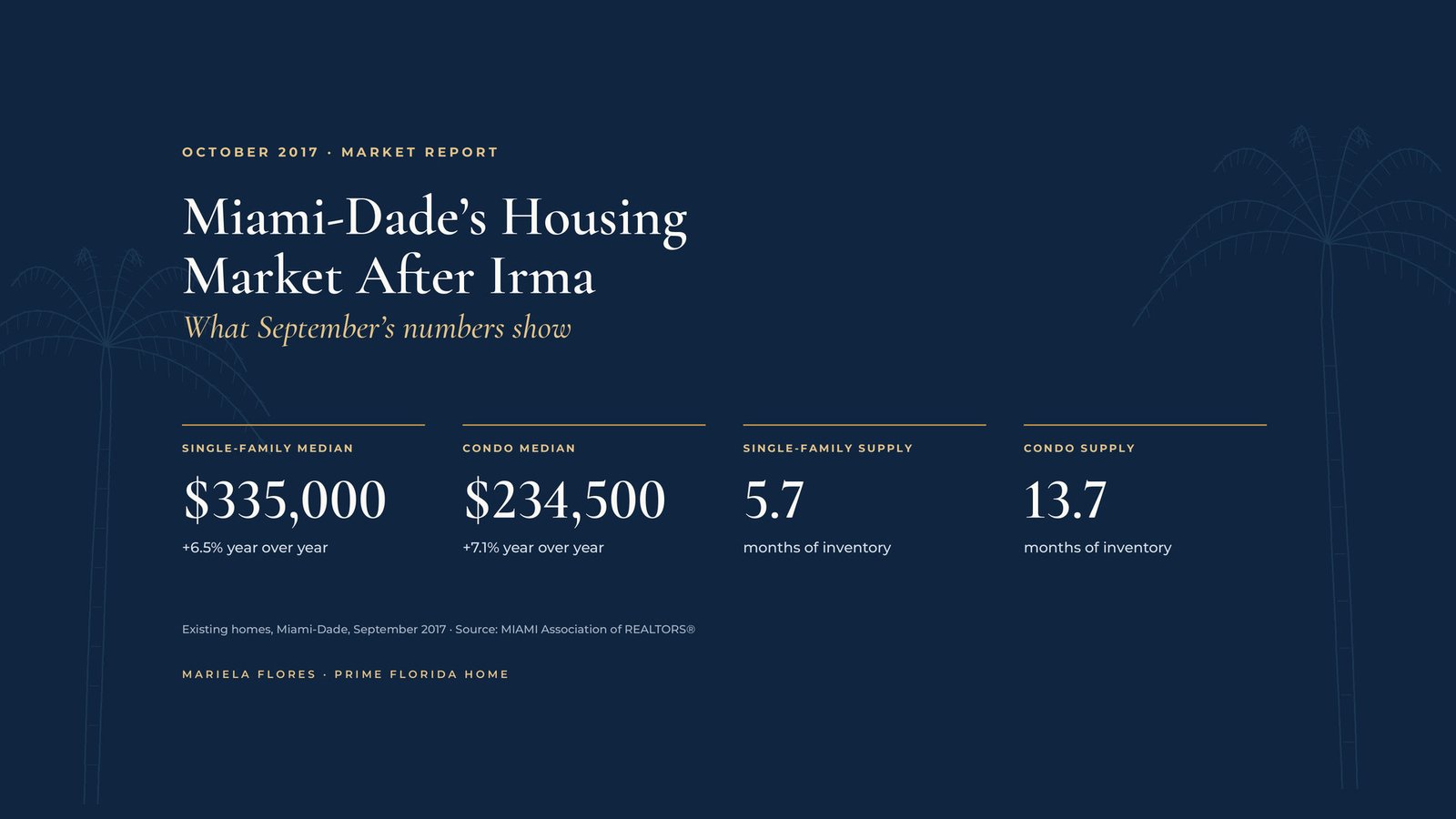
    The median price for an existing single-family home in Miami-Dade was $335,000 in September, up 6.5 percent from $314,500 a year earlier. That marked 70 consecutive months of single-family price increases, a streak of nearly six years. The median existing-condominium price was $234,500, up 7.1 percent from $219,000, with condo prices up in 73 of the last 76 months.

    Homes that did close also sold fairly close to list. Single-family sellers received a median of 95.1 percent of the original asking price, and condominium sellers received 93.2 percent. The median time from listing to contract was 41 days for single-family homes, down from 45 days a year earlier, and 93 days for condominiums, unchanged.

    Distressed sales kept fading into the background. They accounted for 9.1 percent of closed residential sales in September, including bank-owned properties and short sales, compared with 16.4 percent in September 2016 and 70 percent in 2009.

    Two markets: single-family and condominium

    Inventory is where the two sides of the market look least alike. Active single-family listings fell 4.8 percent year over year, from 6,368 to 6,060. That equaled 5.7 months of supply, which the Association classifies as a seller’s market. Active condominium listings rose 5.2 percent, from 14,106 to 14,834, or 13.7 months of supply, which it classifies as a buyer’s market. The Association defines a balanced market as six to nine months of supply. Total active listings were 20,894, up 2.1 percent from 20,474 a year earlier, and still about 60 percent below 2008 levels.

    Existing condominiums are also competing with a large new-construction market, and financing remains a constraint. Of 9,307 condominium buildings in Miami-Dade and Broward counties, only 12 were approved for Federal Housing Administration loans, down from 29 a year earlier, according to the Florida Department of Business and Professional Regulation and the FHA, as cited by the Association.

    Cash buyers remain a much larger share of this market than they are nationally. Cash transactions were 43.5 percent of September closings in Miami-Dade, more than double the national figure of 20 percent. The share was 57.6 percent of condominium closings and 27.0 percent of single-family closings. The Association links the high condominium cash share in part to the lack of financing approvals for many buildings.

    What this means as the season begins

    For buyers, September’s lower closing count should not be read as a sudden opening of the floodgates, especially in single-family homes, where supply remains on the seller’s side of balanced. It may mean you will see some delayed listings come to market as cleanup finishes, and it does mean you should leave room in a contract for inspections and a careful appraisal.

    For sellers, the price trend and the list-price ratios suggest that a well-prepared home, priced in line with recent comparables, still has a path to a solid result. Condominium sellers should be more precise, because buyers have more existing and new inventory to compare.

    Mortgage rates have stayed relatively modest this month. Freddie Mac’s weekly survey put the average 30-year fixed rate, with 0.5 points, at 3.85 percent, 3.91 percent, 3.88 percent, and 3.94 percent in the four weeks ending October 5, 12, 19, and 26. The 15-year fixed rate was 3.15 percent, 3.21 percent, 3.19 percent, and 3.25 percent. Those are national averages, not a quote, but they are the backdrop against which local buyers are shopping.

    If you would like to talk about what these figures mean for a particular property or a search you have underway, I am here to walk through them with you.

    You can reach me at (305) 409-2815 or mflores@primefloridahome.com.

    Warmly,
    Mariela

    Restored to our archive in 2026, reflecting the market as of October 2017