Category: Market Insights

Evidence-based insights and real estate market context in Miami-Dade.

  • Tamiami 33182 in 2025: A Year-End Look at Single-Family Home Sales

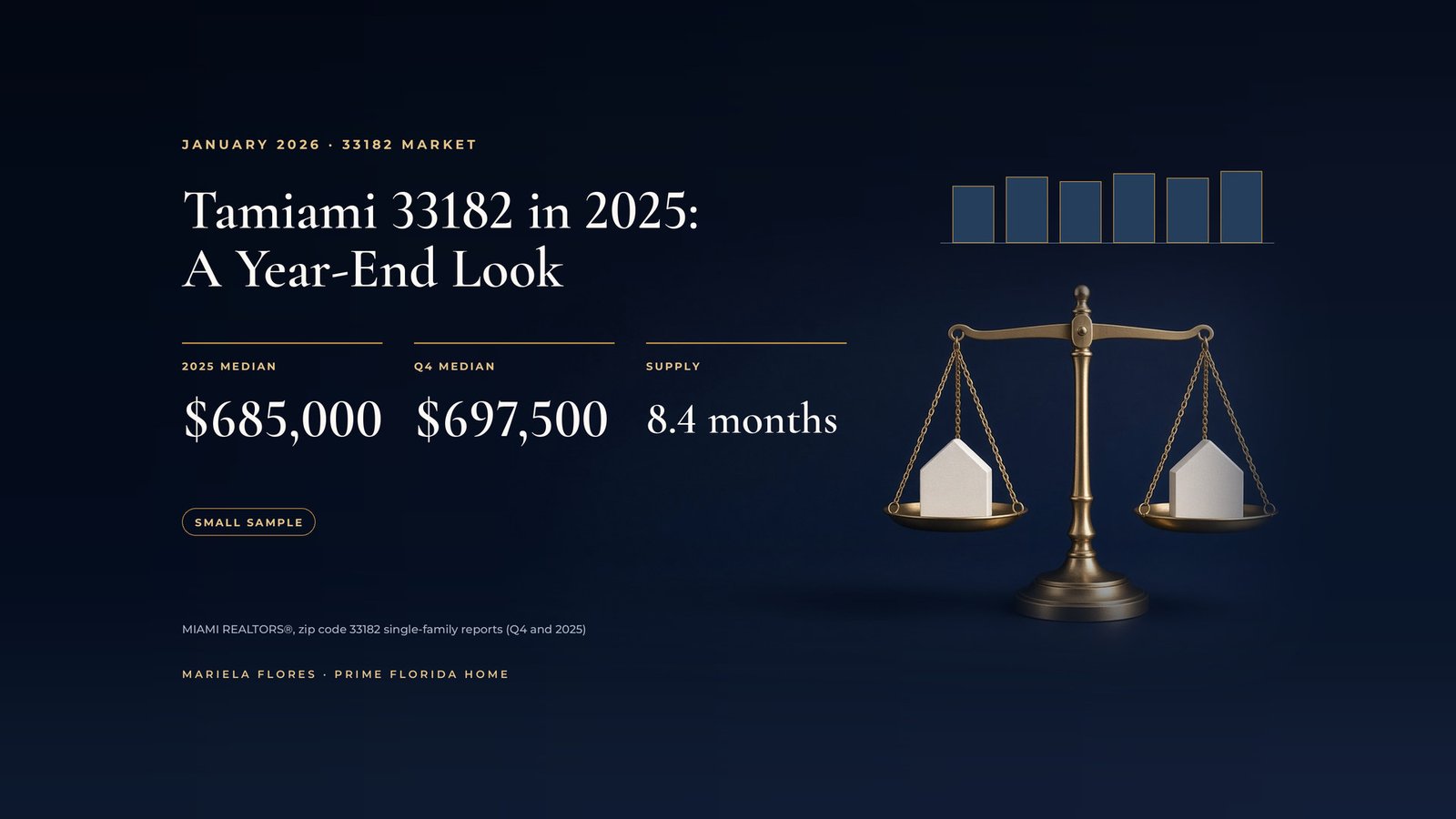
    Tamiami 33182 in 2025: A Year-End Look at Single-Family Home Sales

    Last October, I shared the second-quarter numbers for zip code 33182 in northern Tamiami. Now the full picture for 2025 is in. On January 16, MIAMI REALTORS released its fourth-quarter and full-year reports by zip code, so here’s a look at how single-family homes in zip code 33182 did last year, how that compares with the county, and an honest reminder about small numbers. All of the figures below come from those single-family reports, so they don’t include condos or townhouses.

    Zip code 33182: the fourth quarter

    For October through December 2025, MIAMI’s report shows the following for single-family homes in zip code 33182:

    MeasureQ4 2025Change from Q4 2024
    Closed sales15Up 50 percent
    Median sale price$697,500Up 8.6 percent
    Median percent of original list price received96.2 percentDown 1.8 percent
    Median days to contract32Up 28 percent
    New listings23Up 76.9 percent
    Active inventory (end of quarter)35Up 66.7 percent
    Months of supply8.4Up 64.7 percent

    Zip code 33182: all of 2025

    For the full year, the report shows:

    Measure2025Change from 2024
    Closed sales50Up 2 percent
    Median sale price$685,000Down 7.7 percent
    Median percent of original list price received96.6 percentDown 1 percent
    Median days to contract32Up 3.2 percent
    New listings107Up 32.1 percent
    Months of supply (year-end)8.4Up 64.7 percent

    How the county compares

    The same reports include Miami-Dade County as a whole. For all county single-family homes in 2025, there were 10,210 sales, down 4.9 percent, with a median price of $665,000, up 2.3 percent. The county’s median time to contract was 53 days, the median percent of original list price received was 94.8 percent, and there were 6.2 months of supply at year-end.

    In the fourth quarter alone, the county recorded 2,501 single-family sales, up 5.3 percent, with a median price of $670,000, up 0.8 percent, a median of 94.3 percent of original list price received, and a median of 53 days to contract.

    A small-sample caution

    Please read the 33182 numbers with care. Fifty sales in a year, and 15 in a quarter, is a small sample, and it’s too few to call a trend. One or two sales at an unusually high or low price can move the median noticeably, and percentage changes can look dramatic when the starting number is small. For example, a 50 percent rise in quarterly sales here means about five more homes sold, and the fourth-quarter median rose while the full-year median fell. Both are true, and neither tells the whole story alone.

    So I treat zip code data as one clue, not a conclusion. Recent sales of similar homes, condition, lot, and updates matter much more for any one property.

    What the 2025 numbers show

    With that caution in mind, here is what the report shows for 2025:

    • More listings. New listings rose about a third for the year, and active inventory at year-end was up about two-thirds.
    • More supply than the county. Months of supply at year-end was 8.4 in 33182, compared with 6.2 countywide.
    • Time to contract. The median was 32 days in 33182, both for the year and the fourth quarter, compared with 53 days countywide, and sellers received a median of 96.6 percent of original list price for the year.

    Getting to know the area

    Zip code 33182 covers part of northern Tamiami, including areas such as Belen and Lake Pointe/Imperial Lakes. A few places that help you get your bearings:

    • North Trail Park, a county park at 780 NW 127th Avenue, has a recreation center, a playground, tennis courts, a lighted skate ramp, and a soccer field.
    • Imperial Lake, a planned community at 12301 NW 7th Lane, has 1,257 residential units, according to its management company, with a pool, tennis court, sauna, clubhouse, and security.
    • Schools nearby include Paul W. Bell Middle School at 11800 NW 2nd Street and the Early Childhood Center of Marjory Stoneman Douglas Elementary at 11920 NW 2nd Street. For school assignments, check with Miami-Dade County Public Schools.
    • Dolphin Mall (11401 NW 12th Street) and Florida’s Turnpike are just east.

    What this means for you

    If you’re thinking of selling in 33182:

    • Price with recent, similar sales. With more homes for sale, buyers have choices, and pricing in line with the market helps you stand out.
    • Prepare before you list. Spring is often a busy season, so January and February are good months for repairs and paperwork.
    • Check your homestead and portability. If you’re selling to buy another Florida home, my January 13 post explains how portability may help.

    If you’re thinking of buying:

    • Take your time. More inventory can mean more options and room for inspections and questions.
    • Get pre-approved. An updated conversation with a lender helps you know your budget before you start touring.

    The bottom line

    In 2025, single-family homes in zip code 33182 saw more listings and more supply, with a median time to contract of about a month, all with the caution a small sample deserves. If you’d like a closer look at recent sales on your street or a home you’re considering, I’m happy to put them together for you, with no pressure.

    You can reach me at (305) 409-2815 or mflores@primefloridahome.com.

    Warmly,
    Mariela

    Restored to our archive in 2026, reflecting the market as of January 2026

  • Owning a Miami Rental in 2026: Softer Rents, Lower Citizens Rates, and Bills to Watch

    Owning a Miami Rental in 2026: Softer Rents, Lower Citizens Rates, and Bills to Watch

    If you own a rental in Miami-Dade, whether it’s a condo you kept when you moved, a duplex, or a single-family home, January is a good month for a check-up. This year, three pieces of news arrived in the same week: asking rents are a little lower than a year ago, Citizens announced its largest rate cut in years, and the 2026 legislative session opened with rental bills on the list. Here’s a calm look at each and a simple to-do list.

    Rents: a little softer than a year ago

    Realtor.com’s December 2025 rental report, published January 15, put the median asking rent for 0- to 2-bedroom units in the Miami-Fort Lauderdale-West Palm Beach metro at $2,262. That’s down 3.4 percent from a year earlier.

    That isn’t a dramatic drop, but it matters at renewal time. When asking rents ease, a good tenant who renews on time is worth a lot, and pricing a renewal or a new listing in line with today’s market is usually smarter than pushing for a large increase and risking a vacancy. A month or two of vacancy can cost more than a modest increase brings in.

    Citizens: lower rates at renewal starting this spring

    On January 12, Governor DeSantis announced new rates for Citizens Property Insurance. According to the Governor’s office:

    • Statewide: the average Citizens rate will fall 8.7 percent.
    • Miami-Dade: about 42,000 homes will see an average reduction of 14.0 percent.
    • Broward and Palm Beach: average reductions of 14.1 percent and 11.9 percent.
    • Timing: the reductions take effect at policy renewal beginning in spring 2026.

    The Florida Phoenix reported that Citizens now has about 400,000 policies, down from 1.3 million in 2023, as many policies have moved back to private insurers. The Governor’s office also noted that 17 new insurance companies have entered Florida since the recent reforms.

    Two cautions. First, a rate is not the same as your premium. Your premium also depends on your coverage amount, your home’s features, and your policy type, so your renewal may not drop by the average. Second, Citizens rates for rental and non-homestead properties can differ from rates for primary homes, so look at your own renewal notice closely.

    Even if you’re not with Citizens, this is a good year to compare. The Governor’s office cited recent decreases filed by several private insurers as well.

    Bills to watch in the 2026 session

    Florida’s legislative session opened on January 13 and runs into March. One bill on my radar for landlords is SB 716, filed on December 18, 2025. As filed, it would:

    • Extend the notice period for unpaid rent from 3 days to 5 days (excluding weekends and legal holidays) before a landlord may terminate a lease for nonpayment.
    • Bar fees or surcharges during that 5-day period.
    • Void lease clauses that require a tenant to pay an extra fee each rental period for a set time because of a missed or late payment.

    As filed, the bill would take effect July 1, 2026. It’s a proposal only. Bills change, and many don’t pass, so nothing changes for your leases today. I’ll share an update when the session ends.

    Your January landlord to-do list

    • Shop your insurance. Ask your agent to compare your current policy with Citizens’ new rates and private options before your renewal.
    • Review your lease. Make sure it matches current Florida law, and have a real estate attorney review any changes. If SB 716 or a similar bill passes, you may need to update your notice and late-fee terms.
    • Price renewals with care. Look at comparable rentals near your property before setting a renewal rate.
    • Organize tax records. January is a good time to gather 2025 rent receipts, repair invoices, insurance bills, and property tax statements for your tax professional.
    • Check your homestead status. Rental properties don’t qualify for a homestead exemption. If you moved out of a former homestead and now rent it, talk with the Property Appraiser’s office about your status.
    • Screen fairly and consistently. Use the same written criteria for every applicant, such as income, rental history, and credit, and follow fair housing laws. Never make decisions based on race, color, religion, sex, disability, familial status, national origin, or any other protected class.

    Thinking about buying a rental?

    If you’re considering an investment property, the math deserves care. With softer asking rents, a mortgage rate of about 6.06 percent (Freddie Mac’s average for January 15), and insurance that varies widely by property, I always suggest running the numbers with a conservative rent and a real insurance quote, not an estimate. Condo associations may also have rental rules or waiting periods, so read the documents before you make an offer.

    The bottom line

    Rents have eased a little, insurance relief is on the way for many Citizens policyholders, and a few rental bills are worth watching. If you’d like help looking at comparable rents, thinking through a sale, or weighing a new rental property, I’m happy to help, with no pressure.

    You can reach me at (305) 409-2815 or mflores@primefloridahome.com.

    Warmly,
    Mariela

    Restored to our archive in 2026, reflecting the market as of January 2026
  • Miami-Dade Housing Market, January 2026: What November’s Numbers Tell Us

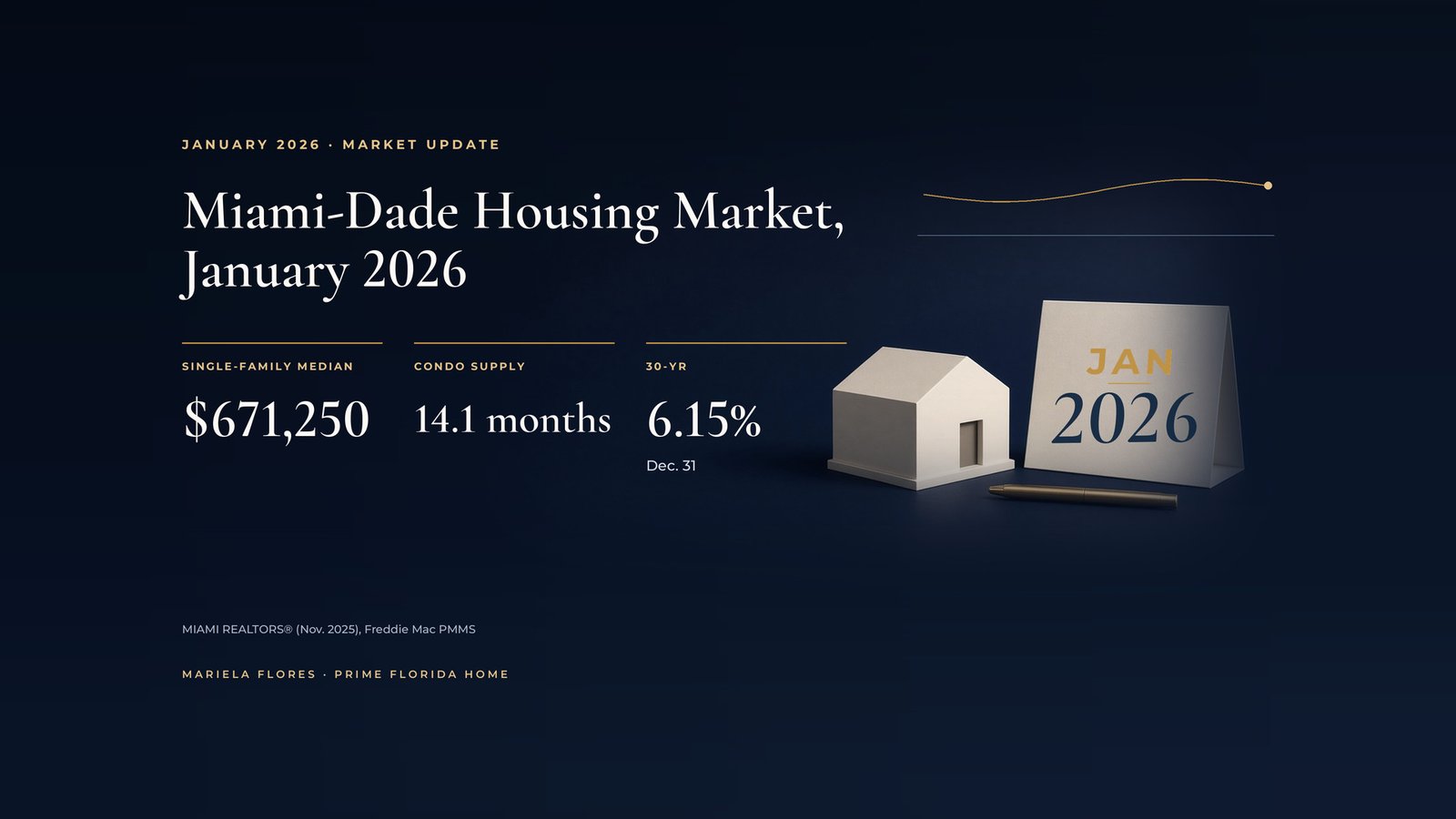
    Miami-Dade Housing Market, January 2026: What November’s Numbers Tell Us

    Happy New Year! January is when many of my clients sit down and ask the big question: is this the year to buy, sell, or stay put? There’s no single right answer, but good numbers make the conversation easier. So here is my first market update of 2026, built on the most recent county figures available today, which cover November 2025.

    A quick note on timing: MIAMI REALTORS released its November 2025 statistics on December 19. December and full-year 2025 figures are scheduled for mid-January, and I’ll share them here once they’re out.

    Single-family homes: steady prices, rising sales

    For Miami-Dade single-family homes in November 2025:

    • Sales: 754, up 5.3 percent from 716 a year earlier. MIAMI noted this was the third consecutive month of year-over-year sales gains.
    • Median price: $671,250, up 3.3 percent from $650,000. According to MIAMI, the single-family median has risen in 167 of the last 168 months.
    • Time to contract: a median of 46 days, up from 36 days.
    • Price received: a median of 94.2 percent of original list price, compared with 95.6 percent a year earlier.
    • Inventory: 5,554 active listings, up 15.8 percent.
    • Months of supply: 6.5 months, up from 5.4.

    MIAMI describes six to nine months of supply as a balanced market, and that’s where single-family homes sit right now. In everyday terms, buyers have more choices and a bit more time than they did during the rush of recent years, while well-priced homes are still selling.

    Condos: more room to negotiate

    Condos tell a different story. In November 2025:

    • Sales: 764, down 3.8 percent from 794.
    • Median price: $395,000, down 9.5 percent from $436,354.
    • Months of supply: 14.1 months, up from 11.
    • Time to contract: a median of 72 days, up from 50.

    There are bright spots inside those numbers. Sales of condos priced between $200,000 and $400,000 rose 21 percent, from 135 to 164. MIAMI also reported that, year to date, condos in buildings 30 years or older spent less time on the market than those in newer buildings, 66 days versus 81. To me, that says buyers are still very interested in older buildings when the price and the paperwork make sense.

    With more than a year of supply, condo buyers generally have room to negotiate. For condo sellers, pricing and preparation matter more than ever.

    Total sales and the higher end

    Total Miami-Dade sales rose 0.5 percent, from 1,510 to 1,518. Sales of $1 million and up increased 13.2 percent, from 272 to 308, and total dollar volume rose 8.49 percent to $1.4 billion.

    Mortgage rates and the Fed

    Rates are a big part of the story heading into 2026. Freddie Mac’s 30-year fixed rate averaged 6.15 percent on December 31, which Freddie Mac described as its lowest level of 2025. A year earlier, it averaged 6.91 percent.

    On December 10, the Federal Reserve lowered its target range for the federal funds rate by a quarter point, to 3.5 to 3.75 percent, its third cut of 2025. The Fed’s next meeting is January 27 and 28. Mortgage rates don’t move in lockstep with the Fed, so I always suggest watching the actual rate quotes you receive rather than the headlines.

    What MIAMI expects for 2026

    MIAMI’s chief economist, Gay Cororaton, wrote on December 19 that falling rates in the second half of 2025 “kicked up homebuying.” For Southeast Florida, she projected single-family sales to rise 5 percent in 2026 and single-family prices to rise 3 percent. A forecast is a forecast, not a promise, but it’s a helpful frame.

    What this means for you

    If you’re buying:

    • Get an updated pre-approval. Rates near 6 percent change your monthly payment compared with a year ago, so it’s worth a fresh conversation with a lender.
    • Use your time well. A balanced single-family market and a soft condo market mean you can be thoughtful about inspections, questions, and documents.
    • For condos, read the building’s records. Ask about reserves, recent inspections, and any planned assessments before you fall in love with a view.

    If you’re selling:

    • Price with today’s data. Buyers can compare, so homes priced in line with recent sales tend to move; overpriced homes tend to sit.
    • Plan for negotiation. With a median of about 94 percent of original list price, many sales include some give and take.
    • Prepare early. Small repairs, clear disclosures, and organized documents help buyers feel confident, especially in the condo market.

    If you’re staying put:

    • Know your numbers. If you bought or refinanced at a higher rate, it may be worth asking a lender whether a refinance makes sense for you.

    The bottom line

    Miami-Dade starts 2026 with a balanced single-family market, a condo market that favors buyers, and mortgage rates at their lowest level of 2025. Whatever your plans are this year, I’m happy to look at the numbers for your home or your search with you, at your pace and with no pressure.

    You can reach me at (305) 409-2815 or mflores@primefloridahome.com.

    Warmly,
    Mariela

    Restored to our archive in 2026, reflecting the market as of January 2026
  • Tamiami 33182 Home Prices in 2025: A Balanced Market Takes Shape in Miami-Dade

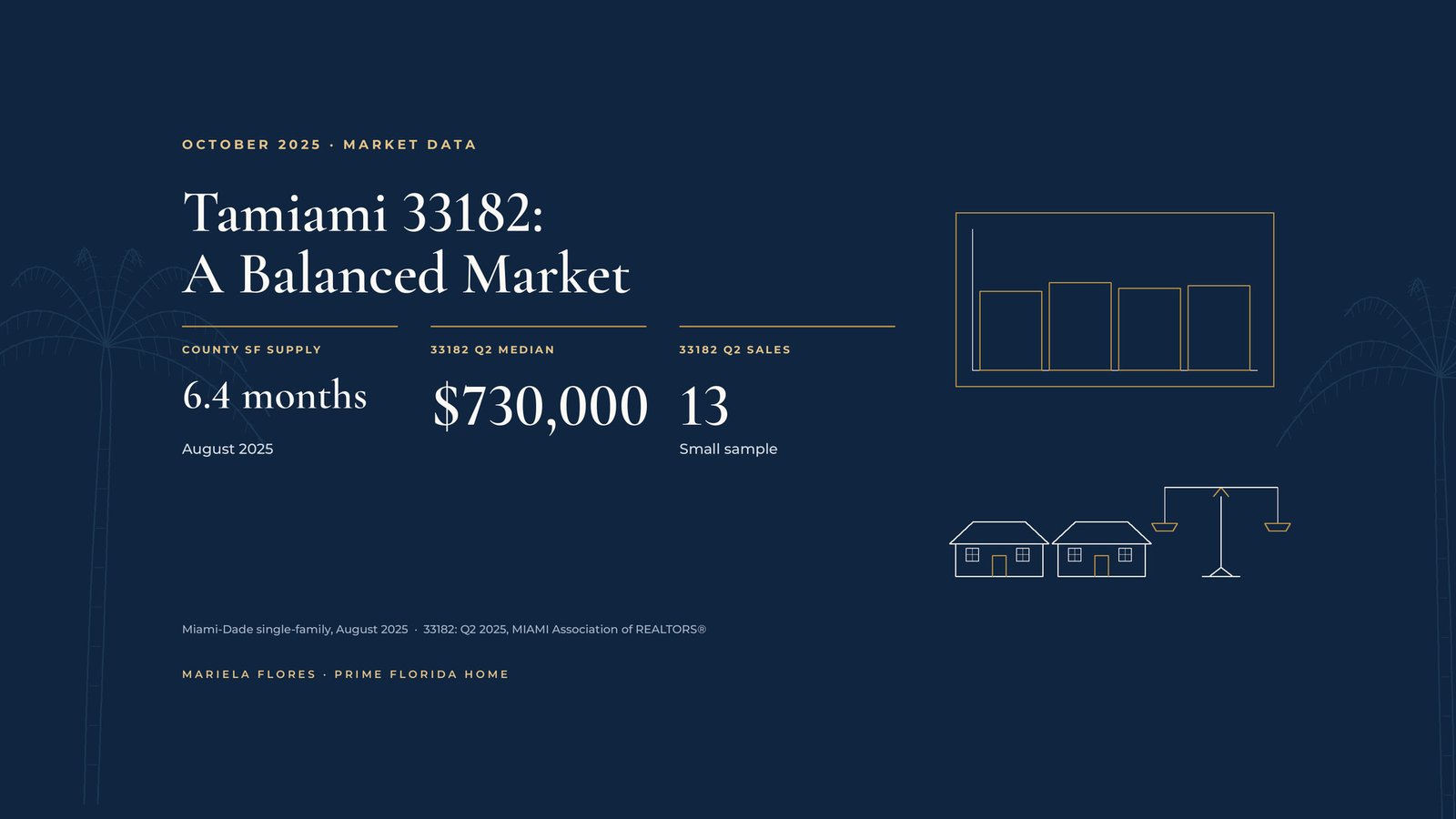
    Tamiami 33182 Home Prices in 2025: A Balanced Market Takes Shape in Miami-Dade

    One question I hear often in Tamiami these days is, “Is it a buyer’s market now or a seller’s market?” For single-family homes across Miami-Dade, the most accurate answer this fall is “neither, really.” The market has been moving toward balance. Here’s a look at the latest county numbers and the most recent quarterly data for the 33182 ZIP code, with an important caution about small numbers.

    Miami-Dade: a balanced single-family market

    MIAMI REALTORS released its August 2025 data on September 23. For Miami-Dade single-family homes:

    • Sales: 885, down 8.2 percent from 964 a year earlier.
    • Median price: $655,000, up 2.3 percent from $640,000.
    • Inventory: 5,361 active listings, up 28.2 percent from 4,183.
    • Months of supply: 6.4 months, which MIAMI describes as a balanced market. It defines balance as six to nine months of supply.
    • Time to contract: a median of 51 days, up from 27 days a year earlier.
    • Price received: a median of 94 percent of original list price.

    MIAMI summed it up this way: “The market is moving towards balance, which is healthy after the pandemic home-buying craze.”

    Condos are in a different place. Condo inventory reached 14 months of supply, which MIAMI describes as a buyer’s market, and the median condo price slipped 1.2 percent to $410,000.

    33182: second-quarter 2025 data

    MIAMI REALTORS publishes quarterly reports by ZIP code. The most recent, covering the second quarter of 2025 (April through June) and released on July 23, shows the following for single-family homes in 33182:

    MeasureQ2 2025Change from Q2 2024
    Closed sales13Down 23.5 percent
    Median sale price$730,000Down 2.7 percent
    Median percent of original list price received96.7 percent—
    Median days to contract44Up 175 percent
    New listings23Up 64.3 percent
    Active inventory34Up 183.3 percent
    Months of supply9.3—

    For comparison, the county’s single-family figures for the same quarter were 2,791 closed sales, a median price of $675,000, a median of 95.4 percent of original list price received, a median of 44 days to contract, and 6.6 months of supply.

    A small-sample caution

    Please read the 33182 numbers carefully. Thirteen sales in a quarter is a very small sample. A single sale at a much higher or lower price can move the median significantly, and percentage changes can look dramatic when the base is small. Going from 12 active listings to 34 is a large percentage jump, even though it’s 22 more homes. Likewise, a median of 44 days to contract is up 175 percent, yet it matches the county’s median for the same quarter.

    So I’d treat ZIP-level data as one clue, not a conclusion. What these numbers do suggest, together with the county data, is that buyers in the area had more homes to choose from and more time to decide this spring than a year earlier.

    MIAMI’s third-quarter ZIP code report is expected later this month, and I’ll be looking at it closely.

    Rates and the Fed

    On September 17, the Federal Reserve lowered its target range for the federal funds rate by a quarter point, to 4 to 4.25 percent, its first cut of 2025. Mortgage rates don’t follow the Fed directly, but they have eased this year. Freddie Mac’s 30-year fixed rate averaged 6.27 percent on October 16, down from 7.04 percent in mid-January.

    What a balanced market means for you

    If you’re selling:

    • Price with care. In a balanced market, homes priced in line with recent sales tend to attract attention; overpriced ones tend to sit.
    • Expect negotiation. With a median of 94 percent of original list price countywide, many sellers are negotiating. Plan for it.
    • Present your home well. Repairs, clean documents, and a clear story about the home’s updates help buyers feel confident.

    If you’re buying:

    • Take your time. More inventory means more options and often more room for inspections and questions.
    • Negotiate thoughtfully. Requests for repairs or closing-cost help can be reasonable, but a fair offer still matters.
    • Get pre-approved. Rates have eased this year, so it’s worth an updated conversation with a lender.

    The bottom line

    The single-family market in Miami-Dade is finding its balance, and 33182’s latest quarterly numbers point in the same direction, with the caution that a small sample deserves. If you’d like a closer look at recent sales on your street or a home you’re considering, I’m happy to pull them together, with no pressure.

    You can reach me at (305) 409-2815 or mflores@primefloridahome.com.

    Warmly,
    Mariela

    Restored to our archive in 2026, reflecting the market as of October 2025

  • Florida’s New Condo Law (HB 913): SIRS Relief, Reserve Options, and a Softer Miami Condo Market

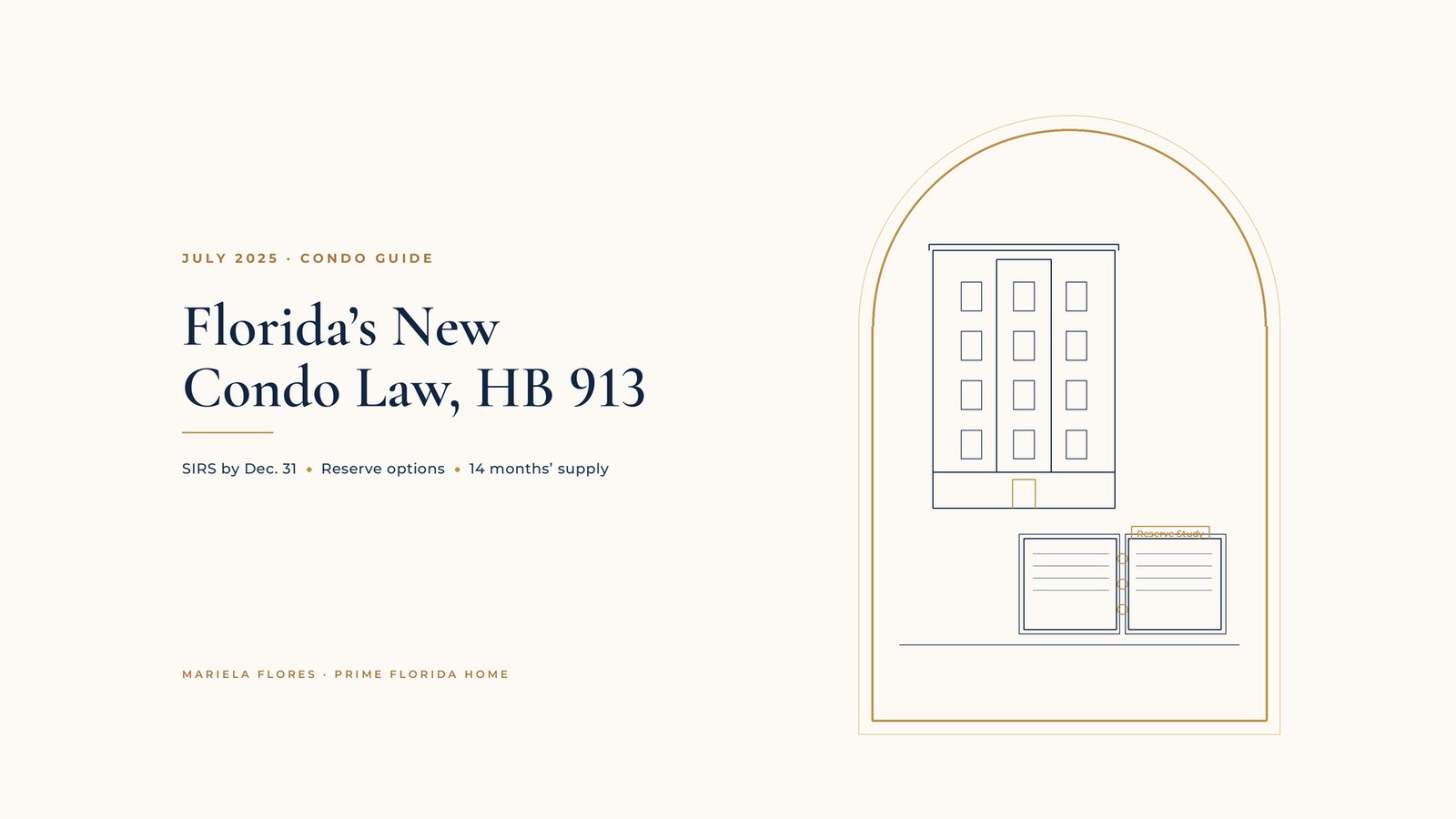
    Florida’s New Condo Law (HB 913): SIRS Relief, Reserve Options, and a Softer Miami Condo Market

    Today, July 1, a new Florida condo law takes effect. If you own a condo, are thinking of selling one, or are shopping for one, this law matters, because it changes some of the timelines and funding rules that have weighed on many buildings since 2022. It arrives as Miami’s condo market is clearly cooling. Here’s a plain-language look at both, from my side of the closing table. For questions about your specific association, its attorney and manager are the best sources.

    What HB 913 is

    House Bill 913 passed both chambers unanimously, 112 to 0 in the House and 37 to 0 in the Senate, and Governor DeSantis signed it on June 23. It became Chapter 2025-175, Laws of Florida, and most of it takes effect today. It builds on the condo safety laws passed after the Surfside collapse, giving associations more time and more ways to plan and pay for repairs while keeping the inspection and reserve framework in place.

    SIRS timing relief

    A structural integrity reserve study, or SIRS, looks at a building’s key components, like the roof, structure, and waterproofing, and estimates what the association should set aside for them. Under the new law:

    • A later deadline. Associations required to complete their first SIRS now have until December 31, 2025.
    • Coordination with inspections. An association whose building needs a milestone inspection may delay its SIRS for up to two budget years so the two can work together.
    • Narrower scope. The law applies the milestone inspection requirement to buildings three habitable stories or more, according to Florida Realtors.
    • A clearer plan. A SIRS must now include a recommended funding plan, including a baseline funding plan, and the threshold for listing other items rises to $25,000 in deferred maintenance or replacement cost.

    Reserve options

    This is where many owners may notice the biggest change:

    • A temporary pause. For budgets adopted on or before December 31, 2028, owners may vote to pause or reduce reserve contributions for up to two budget years after a milestone inspection, so money can go toward the repairs that inspection identified. This takes a majority vote of the total voting interests.
    • Other ways to fund. Associations may fund required reserves through a special assessment, a line of credit, or a loan, with majority approval.
    • More calculation methods. Associations may use a pooled or straight-line method to fund reserves.

    None of this makes repairs disappear. It gives boards and owners more flexibility in timing and in how costs are spread.

    More transparency

    The law also expands what associations must share. According to Florida Realtors, associations required to have a website must post approved meeting minutes from the prior 12 months, and boards may hold meetings by video conference with certain notice requirements.

    For buyers, Florida Realtors reports that the right to cancel a resale contract now runs for seven days after you receive the required association documents.

    A softer condo market

    The law arrives at a time when Miami’s condo market has clearly cooled. According to MIAMI REALTORS’ June 23 report on May data:

    • Prices are flat. The Miami-Dade condo median price was $425,000, unchanged from a year earlier, while statewide condo prices fell 6.1 percent.
    • Fewer sales. Condo sales fell 25.1 percent to 970.
    • More choices. Condo inventory rose 39.5 percent to 13,192 listings, or 14 months of supply.
    • Slower pace. Condos went under contract in a median of 63 days, compared with 46 a year earlier, and sold for a median of 93 percent of original list price.

    Single-family homes remain steadier: the median price rose 3.9 percent to $675,000, with 6.6 months of supply.

    Freddie Mac’s 30-year fixed rate averaged 6.77 percent on June 26.

    If you own or are selling a condo

    • Talk with your board. Ask where the building stands on its milestone inspection, SIRS, and reserve plan, and whether the board expects to use any of the new options.
    • Get your documents together early. Buyers and their lenders will look closely at the SIRS, the budget, reserves, and any planned assessments.
    • Price with today’s data. With 14 months of supply, buyers have time and choices. A realistic price and clear disclosures matter more than ever.

    If you’re buying a condo

    • Read everything. Review the SIRS, the milestone inspection, the budget, and recent minutes. Use your seven days carefully, and ask the association your questions.
    • Plan for future costs. A pause in reserves now can mean larger contributions later. Ask how and when the board expects to fund the work.
    • Use the market’s patience. More inventory can give you room to negotiate, but take your time to understand the building’s finances first.

    The bottom line

    HB 913 gives condo associations more time and more options, and today’s market gives buyers more choices. If you’d like help reading a building’s documents or pricing your condo realistically, I’m here, with no pressure at all.

    You can reach me at (305) 409-2815 or mflores@primefloridahome.com.

    Warmly,
    Mariela

    Restored to our archive in 2026, reflecting the market as of July 2025

  • Miami Condo Market in December 2024: The SIRS Deadline and Rising Condo Inventory

    Miami Condo Market in December 2024: The SIRS Deadline and Rising Condo Inventory

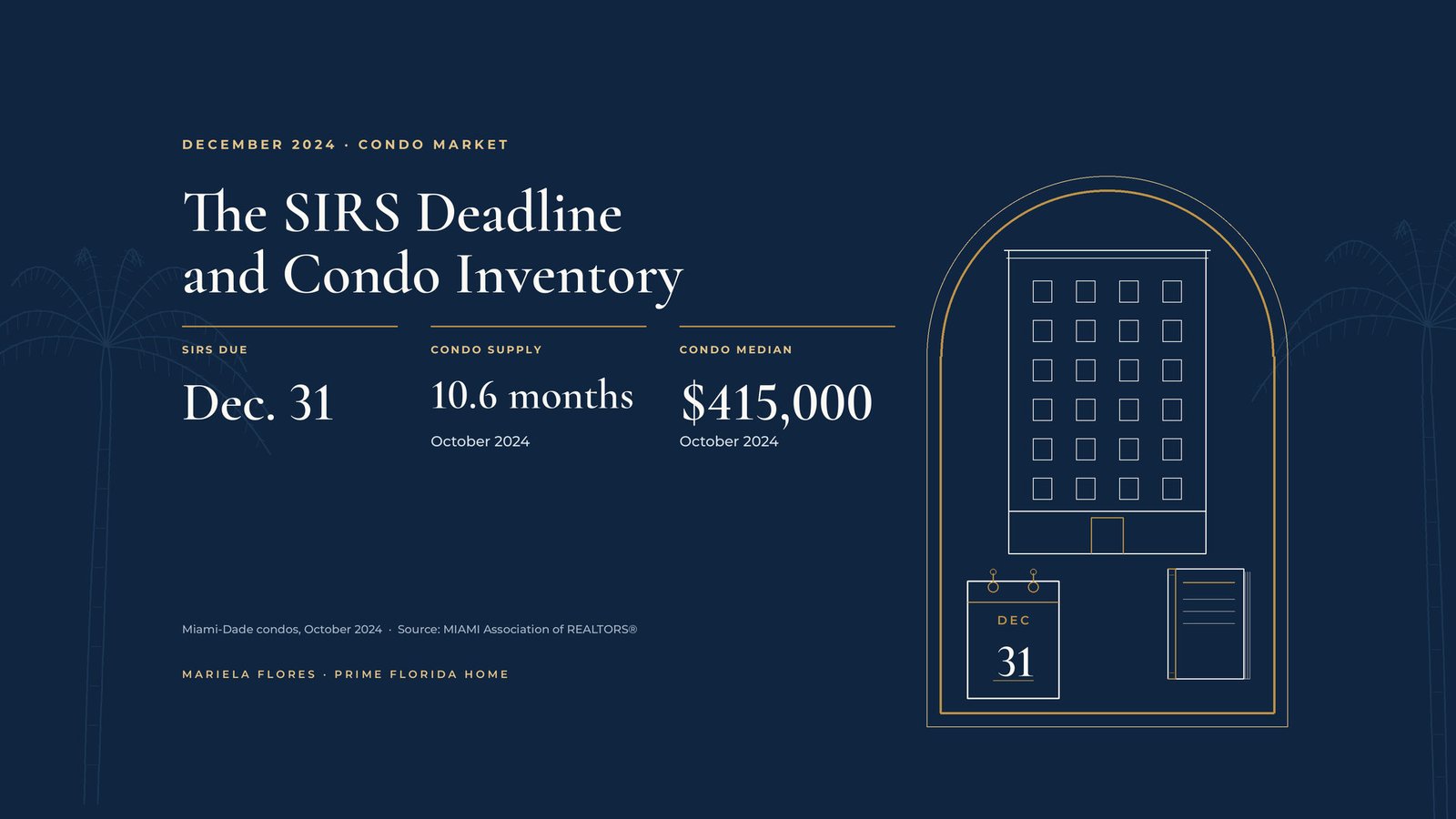
    If you own, or are thinking about buying, a condo in Miami-Dade, December 31 has probably been on your mind. That’s the deadline for many associations to complete their first structural integrity reserve study, or SIRS. At the same time, the number of condos for sale has grown a lot this year. Here’s a calm look at both, and what they mean if you’re selling, buying, or simply staying put. I’m not a lawyer or an engineer, so for your building’s specifics, your association, its documents, and its professionals are the final word.

    The December 31 deadline

    Under Florida law, as written in the 2024 Florida Statutes, condo associations that existed on or before July 1, 2022 and are controlled by unit owners must complete a SIRS by December 31, 2024 for each building that is three stories or taller. After that, a SIRS is required at least every 10 years.

    A SIRS is based on a visual inspection and looks at major components that affect a building’s structural integrity and safety, including:

    • Roof and structure. The roof, plus load-bearing walls and other primary structural members.
    • Systems. Fireproofing and fire protection, plumbing, and electrical systems.
    • The building envelope. Waterproofing and exterior painting, and windows and exterior doors.
    • Other major items. Any other item with a deferred maintenance or replacement cost over $10,000 whose failure would affect those components.

    For each item, the study estimates its remaining useful life, its replacement cost, and the reserve funding needed. The association must give owners a copy of the study, or notice that it’s complete, within 45 days of receiving it.

    What changes with the new year’s budgets

    The law also tightens how reserves can be handled. For a budget adopted on or after December 31, 2024, owners in an association that must obtain a SIRS can’t vote to provide no reserves or reduced reserves for the components the study covers, and they can’t vote to use those reserve funds for other purposes.

    In addition, this year’s HB 1021 requires the state’s condo division to create a database of associations that have completed a SIRS by January 1, 2025.

    For some buildings, catching up on reserves can mean higher monthly maintenance fees, a special assessment, or both. Every building is different, and some associations have been funding reserves well for years.

    What’s happening in the condo market

    MIAMI REALTORS reported on November 21 that Miami-Dade condo inventory rose 50.9 percent in October 2024, from 7,255 to 10,946 listings. That’s 10.6 months of supply, above the six-to-nine-month range the association describes as balanced. The association also noted that current inventory is still 28.4 percent below October 2019’s 15,295 listings.

    Condo sales fell 14.6 percent to 939, which MIAMI REALTORS attributed to a lack of condo financing and inventory at key price points. Even so, the median condo price rose 2.5 percent to $415,000, and condos sold for a median of 94.7 percent of original list price.

    The release also pointed to a financing hurdle: of 2,374 condo buildings in Miami-Dade, Broward, and Palm Beach counties, only 23 were approved for FHA loans, according to HUD data cited by the association.

    If you’re selling a condo

    With more choices for buyers, preparation matters more than ever:

    • Gather your building’s documents early. Budget, reserves, recent minutes, milestone inspection if any, and the SIRS or its status. Buyers will ask.
    • Know about assessments. If one is approved or likely, we’ll talk about how to disclose it and how it might be handled in negotiations.
    • Price with today’s data. Recent sales in your building and similar buildings matter more than last year’s highs.
    • Make your unit easy to say yes to. Small repairs and good photos help a listing stand out among many.

    If you’re buying a condo

    More inventory gives you time and negotiating room, but take your time on due diligence too:

    • Ask for the SIRS. Is it complete? What does it recommend, and how does the budget fund it?
    • Ask about assessments. Are any approved, discussed, or likely?
    • Check financing early. Ask your lender whether the building qualifies for the loan you plan to use.
    • Read the minutes. They often show what’s coming before it shows up in the budget.

    If you’re staying put

    Read the study when your association shares it, attend the budget meeting, and ask questions. If an assessment is coming, ask about payment options. Knowing the plan is far less stressful than guessing.

    Rates and single-family homes

    On the single-family side, MIAMI REALTORS reported a median price of $670,750 in October, up 8.5 percent, with 4,660 homes for sale, or 5.2 months of supply. Freddie Mac’s 30-year fixed rate averaged 6.69 percent on December 5.

    The bottom line

    The SIRS deadline marks a reset for many Miami condo buildings, and higher inventory means buyers have more choices. Neither is a reason to panic. If you’d like help reading a building’s documents or pricing your condo for today’s market, I’m here, with no pressure.

    You can reach me at (305) 409-2815 or mflores@primefloridahome.com.

    Warmly,
    Mariela

    Restored to our archive in 2026, reflecting the market as of December 2024

  • The Fed’s First Rate Cut in Four Years: What It Means for Miami Mortgage Rates, With a Look at 33182

    The Fed’s First Rate Cut in Four Years: What It Means for Miami Mortgage Rates, With a Look at 33182

    Last Wednesday, the Federal Reserve cut interest rates for the first time in four years, and my phone has been busy since. The most common question: “Does this mean mortgage rates just dropped?” The honest answer is “partly, and mostly already.” Here’s what the Fed did, what it does and doesn’t mean for your mortgage, and a look at recent numbers for Miami-Dade and our own corner of the northern Tamiami area, zip code 33182.

    What the Fed did

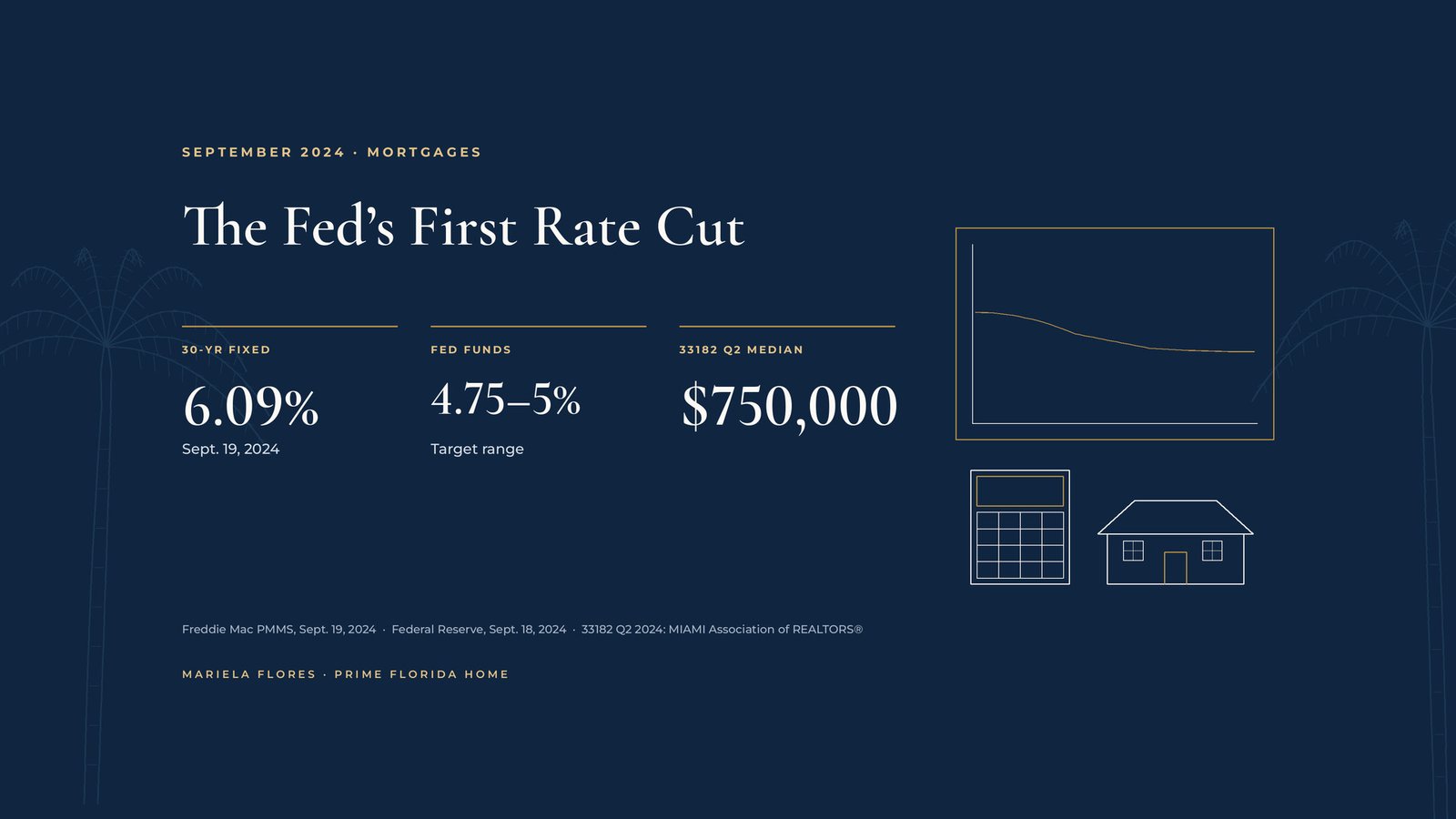
    On September 18, the Federal Reserve announced it was lowering its federal funds target range by half a percentage point, to 4.75 to 5 percent. In its statement, the Fed said it had gained greater confidence that inflation is moving sustainably toward 2 percent. The decision wasn’t unanimous: one Fed governor, Michelle Bowman, voted for a smaller quarter-point cut.

    MIAMI REALTORS described it as the first rate cut in four years.

    What it means for mortgage rates

    Here’s the part that surprises people: the Fed doesn’t set mortgage rates. The federal funds rate is a short-term rate that banks charge each other overnight. A 30-year mortgage rate tends to follow longer-term borrowing costs and investors’ expectations about the economy and inflation.

    Because markets expected this cut, much of it showed up in mortgage rates before the Fed acted. Look at Freddie Mac’s weekly survey of the 30-year fixed rate:

    • May 2: 7.22 percent, the highest weekly average so far this year.
    • August 22: 6.46 percent.
    • September 19: 6.09 percent, the day after the Fed’s announcement.

    So rates had already come down more than a full point from their spring high.

    What that means in dollars

    Here’s a simple illustration using the standard loan formula, for principal and interest only on a $500,000, 30-year fixed loan:

    • At 7.22 percent: about $3,401 a month.
    • At 6.09 percent: about $3,027 a month.

    That’s a difference of about $374 a month. Your actual rate depends on your credit, down payment, loan type, and the day you lock, and taxes and insurance come on top.

    What it doesn’t mean

    • Rates won’t fall in a straight line. Mortgage rates can rise and fall from week to week, even when the Fed is cutting.
    • Waiting has trade-offs. If rates keep easing, more buyers may come back to the market, and that can mean more competition.
    • A cut doesn’t change your budget overnight. A comfortable monthly payment is still the right starting point.

    If you’re thinking about buying, my suggestion is to get pre-approved now so you know your numbers, and ask your lender how rate locks and float-down options work. If you bought in the past couple of years at a higher rate, it’s worth a quick conversation with your lender about whether refinancing would make sense for you, keeping closing costs in mind.

    Miami-Dade in August

    MIAMI REALTORS reported on September 19 that Miami-Dade single-family home sales rose 1.7 percent in August to 964, and the median price rose 3.2 percent to $640,000, the 153rd consecutive month of year-over-year gains. Inventory rose 36.6 percent to 4,183 homes, or 4.7 months of supply. Homes went under contract in a median of 27 days and sold for 96.8 percent of original list price.

    On the condo side, the median price was $415,000, down 0.2 percent, and sales fell 15.6 percent to 1,038, which MIAMI REALTORS attributed to a lack of condo financing and inventory at key price points. Condo inventory rose 57.6 percent to 10,094, or 9.5 months of supply. Cash purchases made up 32.9 percent of all closed sales.

    A closer look at 33182

    Because so many of my clients live in or near 33182, I looked at MIAMI REALTORS’ zip code report for the second quarter of 2024, released July 23. For single-family homes in 33182, from April through June:

    • Closed sales: 17, up 54.5 percent from a year earlier.
    • Median sale price: $750,000, up 18.9 percent.
    • Percent of original list price received: 97.5 percent.
    • Median days to contract: 16.
    • New listings: 14, with 12 active listings at the end of the quarter.
    • Months of supply: 2.5.

    For comparison, the county’s single-family median for the quarter was $650,000, up 6.6 percent, on 3,133 sales.

    One important caution: 17 sales is a small number, and a few higher- or lower-priced homes can swing the median quite a bit from one quarter to the next. So I’d treat these as a snapshot, not a trend. If you own a home in 33182 and want a clearer picture, a comparative market analysis based on recent sales of homes like yours is much more reliable than any single quarter’s median.

    The bottom line

    The Fed’s cut is good news, but much of it was already reflected in mortgage rates. The best move is still the calm one: know your numbers, talk with a lender, and decide based on your own timeline. If you’d like to run numbers together or see what your home might be worth today, I’m happy to help, with no pressure.

    You can reach me at (305) 409-2815 or mflores@primefloridahome.com.

    Warmly,
    Mariela

    Restored to our archive in 2026, reflecting the market as of September 2024

  • Florida’s December Insurance Law: What SB 2-A Changes for Miami Homeowners in 2023

    Florida’s December Insurance Law: What SB 2-A Changes for Miami Homeowners in 2023

    It has been a hard year for property insurance in Florida. If you received a renewal with a big increase, a nonrenewal notice, or a letter that your insurer was leaving or going out of business, you were not alone. Last week, the Legislature met in a special session to respond, and on December 16 Governor DeSantis signed Senate Bill 2-A. Here is a plain-language guide to what it changes, what it doesn’t, and what Miami homeowners and buyers can do now.

    Why lawmakers met again

    This was the second special session on property insurance this year. As the Associated Press reported during the session:

    • Six insurers became insolvent in 2022, while others were leaving the state.
    • Average annual premiums in Florida topped $4,200, about three times the national average, according to the Insurance Information Institute.
    • Citizens Property Insurance, the state’s insurer of last resort, passed 1 million policies this summer for the first time in almost a decade.

    In May, lawmakers passed SB 2-D, which created a reinsurance program for insurers, set aside $150 million for the My Safe Florida Home program to help homeowners strengthen their homes against hurricanes, and limited when insurers can refuse coverage based only on a roof’s age. SB 2-A builds on those changes.

    What changes in the new law

    These summaries come from the Florida Senate’s summary of the bill. Most provisions take effect immediately, with some exceptions noted below.

    Claims deadlines are shorter

    • New or reopened claims must be reported within 1 year of the loss, down from 2 years.
    • Supplemental claims must be reported within 18 months, down from 3 years.

    If you have damage, report it promptly, take photos, and keep receipts.

    Insurers must move faster

    • Acknowledge your claim communications within 7 days instead of 14.
    • Begin investigating within 7 days instead of 14.
    • Inspect the property within 30 days instead of 45, including for hurricane claims.
    • Pay or deny a claim within 60 days instead of 90, with possible extensions in emergencies.
    • Send you any adjuster’s report estimating the loss within 7 days after it is created.

    Lawsuits and attorney fees

    The law ends “one-way” attorney fees in property insurance lawsuits, which had allowed policyholders who won to recover their attorney fees from the insurer. It also limits bad-faith lawsuits until a court has found that the insurer breached the policy. Supporters say these changes will reduce litigation costs that push up premiums. Whether and how quickly premiums respond will take time to see.

    Assignment of benefits ends for new policies

    For policies issued on or after January 1, 2023, homeowners can no longer sign over their post-loss insurance benefits to a contractor or other third party. Before repairs begin, talk with your insurer about the claim and agree on payment terms with your contractor.

    Changes for Citizens policyholders

    • The 20 percent rule. For personal residential policies renewing on or after April 1, 2023, a Citizens policyholder becomes ineligible to renew if a private insurer offers comparable coverage for a premium no more than 20 percent higher than the Citizens renewal premium.
    • Flood insurance will be required. To stay eligible, Citizens personal residential policyholders will need flood insurance, phased in over time:
      • Homes in FEMA special flood hazard areas: new Citizens policies effective on or after April 1, 2023, and renewals on or after July 1, 2023.
      • All other homes: March 1, 2024, for dwellings insured for $600,000 or more; March 1, 2025, for $500,000 or more; March 1, 2026, for $400,000 or more; and March 1, 2027, for all others.

    Other changes

    • Reinsurance help. A new optional program, funded with $1 billion, gives insurers access to reinsurance for the 2023 hurricane season.
    • Optional arbitration. Insurers may offer policies with binding arbitration, but only with a premium discount and only if they also offer a policy without it.
    • Insolvent insurers. When an insurer fails, its policies generally stay in force for 30 days. The law lets regulators extend that by 15 days if needed.

    What you can do now

    1. Read your renewal carefully. Compare coverage, deductibles, and exclusions, not only the premium.
    2. Shop with an independent agent who can quote several insurers.
    3. Strengthen your home. Wind mitigation features can earn discounts. Ask about a wind mitigation inspection and the My Safe Florida Home program.
    4. If you have Citizens, plan for flood coverage. Check your flood zone and get a flood quote now, so you know the cost before the requirement reaches you.
    5. Report any damage promptly under the new, shorter deadlines.
    6. Buyers: get insurance quotes early. Ask about the roof’s age, wind mitigation, and flood zone before your inspection period ends, and include insurance in your monthly budget.

    A realistic view

    These reforms are significant, but they won’t change premiums overnight. Even the governor said the problems “did not occur overnight, and they will not be solved overnight.” The best approach is to stay informed, review your coverage each year, and plan for insurance as a real part of the cost of owning a home.

    If you’d like help thinking through insurance as part of a purchase or sale, I’m happy to talk, with no pressure.

    You can reach me at (305) 409-2815 or mflores@primefloridahome.com.

    Warmly,
    Mariela

    Restored to our archive in 2026, reflecting the market as of December 2022

  • Buying a Home in Miami as the Market Cools: How to Negotiate Again in Late 2022

    Buying a Home in Miami as the Market Cools: How to Negotiate Again in Late 2022

    If you stepped back from house hunting during last year’s bidding wars, you may be wondering whether it’s time to look again. The market this fall is different from the one many buyers remember. Rates are much higher, which makes affordability harder, but buyers also have something they haven’t had in a while: a bit more time and room to negotiate. Here is what the latest numbers show and how to use this moment wisely.

    What the October numbers show

    On November 18, the MIAMI Association of Realtors released October figures for Miami-Dade:

    • Prices are still higher than a year ago. The single-family median rose 17.3 percent to $575,000. The condo median rose 18.9 percent to $388,531.
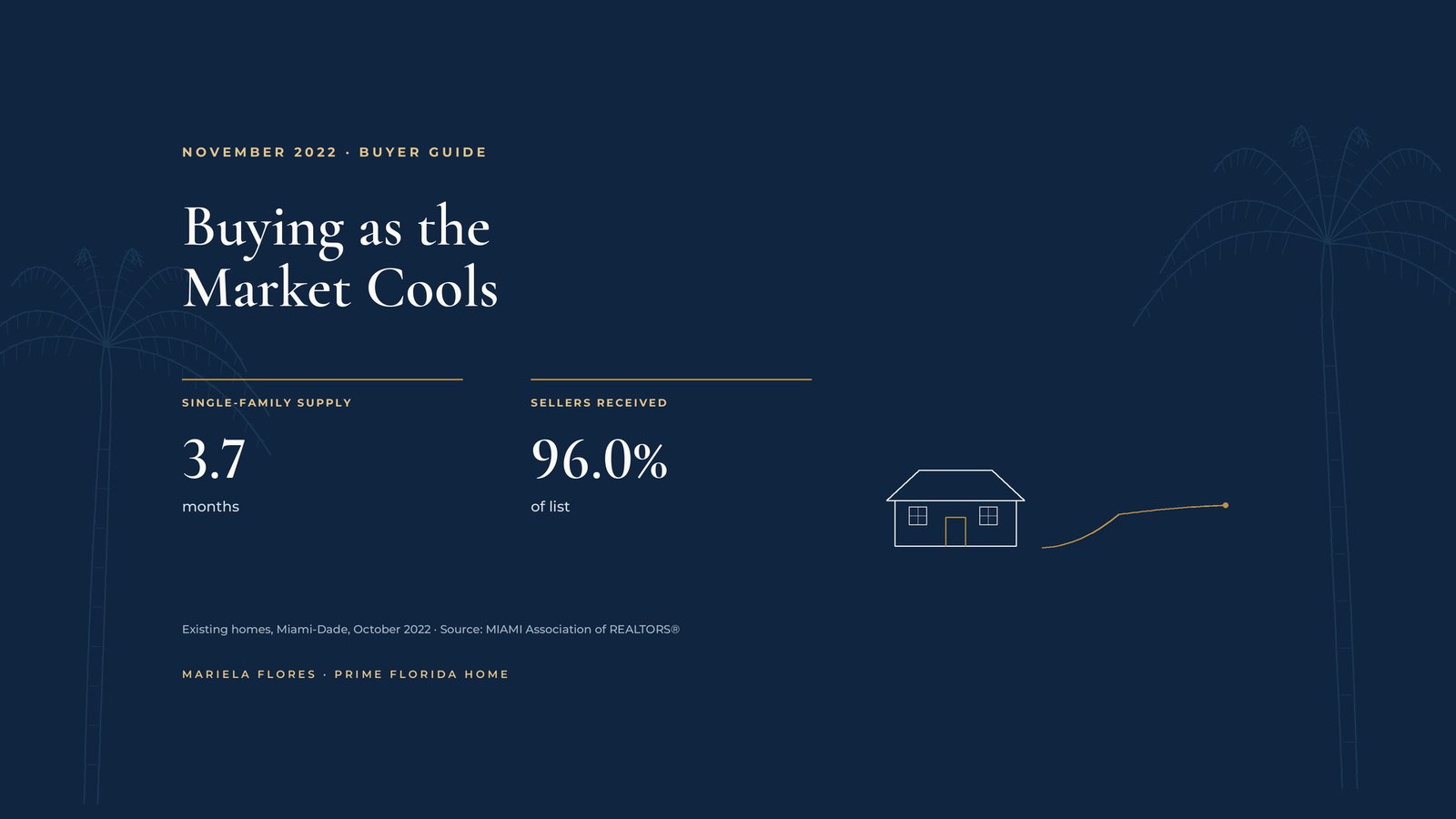
    • More homes to choose from. Single-family inventory rose 41.9 percent to 4,142 listings, a 3.7-month supply, compared with 2.2 months a year earlier. Condos had a 3.8-month supply. Six to nine months is considered balanced, so sellers still have the edge, but it has narrowed.
    • Homes are taking longer to sell. The median single-family home went under contract in 30 days, up from 22. Condos took a median 31 days.
    • Sellers are accepting a bit less. Single-family sellers received a median 96.0 percent of their original list price, down from 98.7 percent. For condos it was 96.9 percent.
    • Fewer new contracts. New pending single-family sales fell 42 percent, a sign that many buyers are pausing.

    Rates are the hard part

    Freddie Mac’s average 30-year fixed rate reached 7.08 percent on October 27 and again on November 10, before easing to 6.61 percent on November 17. A year earlier it was 3.10 percent. On November 2, the Federal Reserve raised its benchmark rate to a range of 3-3/4 to 4 percent and said further increases are likely, while noting it will consider how much it has already tightened.

    On a $400,000 loan, principal and interest at 6.61 percent comes to about $2,557 a month, compared with about $1,708 at 3.10 percent. That is a real difference, and it is why getting your budget right comes first.

    Start with your budget

    • Get a fresh pre-approval. If yours is from earlier this year, it may no longer reflect today’s rates.
    • Set your monthly limit, including taxes, insurance, and any association fees, before you fall in love with a home.
    • Keep a cushion. Leave savings for repairs, moving, and emergencies after closing.

    Where you may have more room to negotiate

    In a cooler market, a fair offer below asking is no longer unusual, especially for a home that has been listed for a while. Every home and seller is different, but these are worth discussing:

    • Price. Look at recent comparable sales and how long the home has been on the market. Make an offer you can support with data.
    • Inspection. With less competition, there is more room to keep a full inspection period and ask for repairs or credits for important issues.
    • Appraisal protection. If you are financing, keeping your appraisal contingency protects you if the home appraises below the price.
    • Closing costs. Asking the seller for a credit toward closing costs can ease your upfront cash needs. Your lender will tell you the limits for your loan.
    • Timing. A closing date that helps the seller can be worth more to them than a few thousand dollars.

    Temporary rate buydowns

    You may hear about a “2-1 buydown.” In this arrangement, the interest rate is 2 percentage points below the loan’s rate in the first year and 1 point below in the second year, then returns to the full rate from the third year on. The cost can be paid upfront by the buyer or by the seller as a concession.

    As a rough illustration, if your note rate is 6.61 percent on $400,000, the first-year payment would be figured at about 4.61 percent, or roughly $2,053 a month, and the second year at about 5.61 percent, or roughly $2,299, before rising to about $2,557. Your lender will calculate the exact numbers.

    A few cautions:

    • You still qualify at the full rate. Lenders generally require you to qualify at the note rate.
    • The payment rises. Make sure the full payment fits your budget from day one.
    • Don’t count on a refinance. Rates may fall, but no one can promise when.

    Stay steady

    • Don’t rush, but don’t wait for perfect. Trying to time the market exactly is hard. Focus on a home and payment that fit your life.
    • Look carefully at condition and costs. For condos, review budgets, reserves, and any planned assessments. For houses, ask about the roof, insurance, and flood zone.
    • Be respectful in negotiations. Sellers are adjusting too. A clear, well-supported offer tends to go further than a lowball one.

    A more balanced moment

    For the first time in a while, Miami buyers have a little more choice and a little more voice. Higher rates make careful planning essential, but with a solid budget and a thoughtful offer, this can be a good time to find the right home.

    If you’d like help reviewing your budget or preparing an offer, I’m here, with no pressure.

    You can reach me at (305) 409-2815 or mflores@primefloridahome.com.

    Warmly,
    Mariela

    Restored to our archive in 2026, reflecting the market as of November 2022

  • Selling Your Miami Home as the Market Cools: Pricing and Preparing for Fall 2022

    Selling Your Miami Home as the Market Cools: Pricing and Preparing for Fall 2022

    For two years, many Miami sellers listed on a Thursday and had offers by the weekend. This fall feels different. Homes are still selling, and prices are still higher than a year ago, but buyers are more careful, and some listings are taking longer. If you are thinking of selling, that doesn’t mean you missed your chance. It means the approach that worked in 2021 needs a few adjustments. Here is what the latest numbers show and how I would prepare.

    What the August numbers show

    On September 21, the MIAMI Association of Realtors released August figures for Miami-Dade:

    • Sales are lower than last year’s record, but solid. Total sales fell 24.1 percent from a record August 2021, to 2,505. That is still above the 2,341 August average from 2016 to 2019.
    • Prices are still up from a year ago. The single-family median rose 10.1 percent to $551,250, and the condo median rose 11.9 percent to $375,000.
    • More single-family homes are for sale. Inventory rose 26 percent to 3,813 listings, the fourth straight monthly increase, for a 3.3-month supply. Condo inventory fell to 6,300 listings, a 3.4-month supply. Six to nine months is considered balanced, so both are still seller’s markets.
    • Homes take a little longer. The median single-family home went under contract in 21 days, up from 17, and sold for a median 97.7 percent of its original list price, down from 98.7 percent.

    The month-to-month picture is worth noting too. The Miami Herald reported that the single-family median slipped from a record $579,000 in June to $570,000 in July and $551,250 in August. Monthly numbers bounce around, but the trend tells sellers that the steep climb has paused for now.

    The Association’s chairman, Fernando Arencibia Jr., said the Fed’s fight against inflation has brought higher rates and economic uncertainty that “has served to moderate Miami’s record-breaking real estate market.”

    Why buyers are more careful

    Mortgage rates are the biggest reason. Freddie Mac’s average 30-year fixed rate was 6.02 percent on September 15, compared with 2.86 percent a year earlier. On September 21, the Federal Reserve raised its benchmark rate again, to a range of 3 to 3-1/4 percent, and said further increases are likely.

    For a buyer, that means a higher monthly payment for the same price. Many are recalculating their budgets, and they compare homes more closely before making an offer.

    Price for today’s market, not last spring’s

    The most important decision you will make is the list price.

    • Use recent sales. Ask for sales from the last 60 to 90 days, and pay attention to pending sales and current competition. A neighbor’s sale from last spring may not reflect today.
    • Look at listings that haven’t sold. They tell you what buyers are passing on.
    • Price with care from the start. A home priced right tends to draw more interest in its first weeks. Overpricing and then cutting can cost time and leave buyers wondering what is wrong.
    • Remember the appraisal. If your buyer is financing, the home will need to appraise. A realistic price helps the sale hold together.

    Make your home easy to say yes to

    When buyers have more choices, condition matters more.

    • Handle small repairs before listing: leaky faucets, loose handles, worn caulk, burned-out bulbs.
    • Consider a pre-listing inspection. It can reveal issues you would rather fix or disclose upfront, so there are fewer surprises later.
    • Gather your documents: permits for past work, the roof’s age, any wind mitigation report, insurance details, and, for condos, the association’s budget and rules.
    • Clean, declutter, and invest in good photos. Most buyers see your home online first.

    Florida sellers must disclose known facts that materially affect a home’s value and aren’t readily observable, so work with your agent and, if needed, an attorney on what to share.

    Be ready to negotiate

    In 2021, many sellers could choose among several offers with few conditions. Now, you may see more requests:

    • Inspection repairs or credits. Decide in advance which repairs you are open to.
    • Help with closing costs. A credit toward a buyer’s closing costs can sometimes do more for a sale than a price cut. Your buyer’s lender will set limits on how much you can contribute.
    • Flexible timing. A closing date or short leaseback that works for both sides can make an offer stronger.

    Look at the whole offer, not only the price: financing, deposit, contingencies, and timeline all affect how likely a sale is to close.

    Think about your next step

    If you are selling to buy again, remember that your next purchase will carry today’s rates too. Talk with a lender before you list so you know what you can afford, and plan your timing so you aren’t rushed.

    A steadier market

    A cooling market isn’t a crisis. It is a return to more normal conditions, where preparation and realistic pricing make the difference. Sellers who plan carefully are still doing well.

    If you’d like a pricing review or help preparing your home, I’m happy to walk through it with you, with no pressure.

    You can reach me at (305) 409-2815 or mflores@primefloridahome.com.

    Warmly,
    Mariela

    Restored to our archive in 2026, reflecting the market as of September 2022