Category: Market Insights

Evidence-based insights and real estate market context in Miami-Dade.

  • Rent or Buy in Miami? What Spring 2022 Rents and Prices Mean for Your Next Move

    Rent or Buy in Miami? What Spring 2022 Rents and Prices Mean for Your Next Move

    If your lease renewal arrived recently with a number that made your stomach drop, you are far from alone. Many renters I talk with are asking the same question this spring: keep renting, or try to buy? There is no single right answer, and anyone who tells you otherwise isn’t looking at your situation. What I can do is share what the numbers show right now and walk you through a calm way to compare the two paths.

    What is happening with rents

    On March 23, Realtor.com published its February rental report, and Miami stood out. Among the 50 largest metro areas, the Miami–Fort Lauderdale–West Palm Beach area had the fastest rent growth:

    • The median asking rent for studio to two-bedroom units reached $2,929, up 55.3 percent from a year earlier.
    • Affordability is stretched. Realtor.com estimated that rent for a typical unit here took 59.5 percent of the area’s median household income, the highest share of the 50 metros. Nationally, the median asking rent was $1,792, up 17.1 percent.

    Realtor.com noted that part of Miami’s jump reflects more luxury rentals being listed, so your own increase may be smaller or larger. Still, the direction is clear, and many renters are feeling it.

    It also helps to know that Florida law sharply limits local rent control. Under state statute, a local government can only adopt rent controls in a grave housing emergency, with voter approval, and for no more than one year at a time. So for most renters, the practical decisions are about budget, timing, and options.

    What is happening with home prices

    Buying has gotten more expensive too. On March 18, the MIAMI Association of Realtors released February figures for Miami-Dade:

    • Single-family homes: the median sale price rose 19.1 percent to $536,000. There were 2,212 active listings, just a 1.7-month supply, and homes typically went under contract in 25 days.
    • Condos and townhomes: the median rose 26.7 percent to $380,000. Active listings fell 55.1 percent to 5,272, a 2.6-month supply.

    A balanced market usually has six to nine months of supply, so both segments favor sellers right now.

    Rates are starting to rise

    On March 16, the Federal Reserve raised its benchmark rate to a range of 1/4 to 1/2 percent and said further increases are likely. The Fed doesn’t set mortgage rates, but they have moved up quickly this year. Freddie Mac’s average 30-year fixed rate was 4.16 percent on March 17, compared with 3.09 percent a year earlier.

    Here is a simple illustration. On a $342,000 loan, which is 90 percent of the February condo median, the principal and interest payment is about $1,664 a month at 4.16 percent. At 3.09 percent, it would have been about $1,459. Taxes, insurance, and association fees come on top of that, so your full payment will be higher.

    A calm way to compare renting and buying

    Rather than asking which is better in general, compare the two for your own life over the next few years.

    1. Write down your true monthly cost of renting. Include rent, renter’s insurance, parking, and any fees, and note what your renewal offer would change.
    2. Get a real estimate of owning. A lender can give you a pre-approval and estimate a full payment: principal, interest, property taxes, homeowners insurance, and any condo or HOA fees. Ask about mortgage insurance if you put down less than 20 percent.
    3. Count the upfront cash. Down payment, closing costs, inspections, moving, and a cushion for repairs. Keep an emergency fund after closing.
    4. Think about time. Buying usually makes more sense the longer you expect to stay, because the costs of buying and selling are spread over more years.
    5. Consider flexibility. Renting lets you move easily if your job or family plans might change. Owning gives you more control over your home and a fixed principal and interest payment if you choose a fixed-rate loan.

    If buying is on your mind

    • Talk to a lender early. With rates moving, a pre-approval tells you what you can comfortably afford today, not last year.
    • Look at the whole budget, not only the price. For condos, ask about monthly fees, reserves, and any planned special assessments. For houses, ask about insurance and the age of the roof.
    • Ask about first-time buyer programs. Your lender can tell you which down payment assistance or loan programs you may qualify for.
    • Time your lease. If your lease ends soon, ask your landlord whether a short extension is possible, so you aren’t rushed into a purchase or a move.

    If renting is the better fit for now

    That is a perfectly good choice. You can use this time to build savings, check your credit, and learn the market. Read your renewal carefully, ask questions before you sign, and keep records of your payments. If you plan to buy within a year or two, a quick conversation with a lender now can show you what to work on.

    The bottom line

    Rents and prices have both climbed quickly in Miami, and rates are starting to rise. That makes it more important than ever to compare your own numbers rather than follow headlines. Whichever path you choose, the goal is a home that fits your budget and your life.

    If you’d like help comparing your options, I’m happy to sit down with you, with no pressure.

    You can reach me at (305) 409-2815 or mflores@primefloridahome.com.

    Warmly,
    Mariela

    Restored to our archive in 2026, reflecting the market as of March 2022
  • Why Florida Homeowners Insurance Is Costing More in 2021, and What Miami Owners and Buyers Can Do

    Why Florida Homeowners Insurance Is Costing More in 2021, and What Miami Owners and Buyers Can Do

    If your homeowners insurance renewal arrived this summer with a much higher number, you are in good company. Several clients have called me in the past few weeks with the same question: why is this happening, and what can I do about it? Here is a plain-language look at what is driving costs, what changed in Florida law this year, and practical steps for owners and buyers.

    What homeowners are seeing

    In an NBC 6 report on August 6, an insurance professional said many of her clients were seeing their premiums rise anywhere from 25 to 60 percent at renewal. Mark Friedlander of the Insurance Information Institute said tens of thousands of Floridians had recently received a non-renewal or mid-term cancellation notice. He also said Citizens Property Insurance, the state-created insurer, was adding about 5,000 new customers a week, as fewer private companies write new policies.

    Friedlander pointed to fraudulent roofing claims and rising litigation costs as major drivers, and said private insurers reported more than $1.7 billion in losses in 2020, more than double their 2019 losses, even without a major hurricane hitting Florida.

    What changed in Florida law

    Governor DeSantis signed Senate Bill 76 in June, and most of it took effect July 1. Among the changes:

    • Roof-claim solicitation. Contractors, public adjusters, and companies may not use prohibited advertising that encourages homeowners to file a roof-damage claim, with fines of up to $10,000 for violations.
    • Shorter claim deadlines. The time to file a new or reopened property claim dropped from three years to two, and it now applies to all types of claims, not only hurricanes.
    • Citizens rate cap. The cap on Citizens’ annual rate increases will rise gradually from 10 percent to 15 percent over five years.
    • Litigation rules. The law changed how attorney fees are awarded in many insurance lawsuits.

    Supporters hope these changes will slow premium growth over time, but they won’t erase this year’s increases overnight. The governor himself said more may need to be done.

    If you own a home

    Read your renewal carefully. Compare your coverage, deductibles, and premium with last year’s. Look closely at your hurricane deductible, which is often a percentage of your dwelling coverage rather than a fixed dollar amount. Florida law requires insurers to offer hurricane deductible choices of $500 and 2, 5, and 10 percent of dwelling limits.

    Ask for every discount you qualify for. Florida law requires residential property insurance rate filings to include discounts or credits for features that reduce windstorm losses, such as stronger roof attachments, roof-to-wall connections, and impact windows, doors, or shutters. A wind mitigation inspection documents these features. If you haven’t had one recently, ask your agent whether it could lower your premium.

    Shop around. Ask your agent for several quotes, and consider asking an independent agent who works with different companies.

    Weigh your deductible. A higher deductible can lower your premium, but only choose one you could actually pay after a storm.

    Don’t panic if you get a non-renewal notice. Call your agent right away and ask about your options. Citizens is available to eligible homeowners when private coverage isn’t.

    Be cautious with roof offers. Be wary of anyone who knocks on your door offering a “free” roof through insurance. Call your insurance company or agent first.

    Remember the new two-year deadline for filing claims, and report damage promptly.

    If you own a condo

    In a condo, insurance comes in two layers. Under Florida law, the association must insure the building and common elements based on replacement cost, with an independent appraisal at least every 36 months. The unit owner is responsible for insuring personal property and many items inside the unit, including floor, wall, and ceiling coverings, electrical fixtures, appliances, water heaters, built-in cabinets, countertops, and window treatments.

    That is why your own HO-6 policy matters. Review your interior coverage, ask about loss-assessment coverage, and read your association’s budget. When the association’s insurance costs rise, it can show up in your monthly fees.

    If you are buying

    Insurance is now a key part of your budget, so plan for it early.

    • Get quotes during your inspection period, not after. A real quote for the specific home is far better than an estimate.
    • Ask the seller for the roof’s age and any permits, and for an existing wind mitigation report if there is one. Roof age can affect whether a company will write a policy.
    • Ask your inspector about any additional reports insurers may require for older homes.
    • For condos, ask about the association’s insurance, deductibles, and any planned increases in fees.
    • Don’t forget flood insurance. Standard homeowners policies don’t cover flood, so get a flood quote too.

    A steady approach

    Rising insurance costs are frustrating, and they affect every household budget. Knowing what drives them and asking the right questions puts you in a better position. If you are buying or selling and want help thinking through insurance as part of the plan, I’m always happy to talk, with no pressure.

    You can reach me at (305) 409-2815 or mflores@primefloridahome.com.

    Warmly,
    Mariela

    Restored to our archive in 2026, reflecting the market as of August 2021

  • Buying a Home in a Multiple-Offer Market: How Miami Buyers Can Compete Without Overpaying

    Buying a Home in a Multiple-Offer Market: How Miami Buyers Can Compete Without Overpaying

    If you have been house hunting in Miami-Dade this spring, you may have lost out on a home you loved, sometimes within days of it hitting the market. That is discouraging, and I want you to know it isn’t a reflection on you. The market is simply moving faster than at almost any time on record. Here is what the latest numbers show and how to compete with a clear head, so you can win a home without stretching beyond what feels right.

    A record April

    On May 21, the MIAMI Association of Realtors called April the best April for sales since it began tracking in 1993.

    • Total sales jumped 151.3 percent from a year earlier, to 3,960. Single-family sales rose 83.1 percent to 1,584, and condo sales rose 234.2 percent to 2,376. Keep in mind that April 2020 was the first full month of the pandemic, so the comparison is unusually easy, but sales were also up 50.6 percent from April 2019.
    • Single-family prices rose 34.8 percent to a median of $515,000, the 113th straight month of gains. The condo median rose 22.6 percent to $325,000.
    • Single-family supply is very tight. Inventory fell 54.7 percent to 2,754 listings, a 2.2-month supply. Six to nine months is considered balanced.
    • Homes sell quickly and close to asking. The median single-family home went under contract in 20 days, and sellers received a median 97.9 percent of their original list price.
    • Cash buyers are common. Cash sales made up 37.8 percent of all closings, including 24.7 percent of single-family sales. If you are financing, a strong pre-approval helps you compete with them.

    The Association’s chairman, Jennifer Wollmann, said sales “could have been even larger had there been more inventory.” That is the heart of it: many buyers, few houses.

    Some encouraging signs

    There are reasons for patience. New single-family listings rose 61.6 percent from a year earlier, to 1,773, and the Association expects more inventory later this year as sellers grow more comfortable listing and showing their homes. The condo market is also different: with a 7.1-month supply, the Association described it as balanced, which can mean more choice and more room to negotiate.

    Rates remain low by historical standards. Freddie Mac’s survey put the average 30-year fixed rate at 3.00 percent on May 20.

    Start with your walk-away number

    Before you write an offer, decide the most you are willing to pay for a home, and why. This number should come from your budget, not from the excitement of a bidding war. Think about:

    • The monthly payment you are comfortable with, including taxes, insurance, and any association fees.
    • How much cash you want to keep in savings after closing.
    • How long you plan to stay. The longer you stay, the more time you have to ride out ups and downs in prices.

    When you know your number, you can bid confidently and walk away without regret if the price goes past it.

    Make your offer stronger without taking on hidden risk

    Get fully pre-approved. A pre-approval based on documents your lender has reviewed carries more weight than a quick pre-qualification. Ask your lender to be ready to speak with the listing agent.

    Understand appraisal gaps. When homes sell above recent comparable sales, the appraisal may come in below the contract price. If that happens, your lender will base the loan on the lower value, and you would need to cover the difference in cash, renegotiate, or cancel if your contract allows. Some buyers offer to cover part of a possible gap. If you consider this, set a firm dollar limit you can truly afford and make sure the cash is available.

    Be careful with escalation clauses. An escalation clause raises your offer by a set amount above a competing offer, up to a cap. It can help, but it also reveals your ceiling, and not every seller accepts them. Discuss the wording with your agent and attorney.

    Don’t give up your inspection lightly. Waiving an inspection to look more attractive can be costly in Miami, where roofs, plumbing, electrical systems, and water intrusion can hide expensive problems. Instead, consider a shorter inspection period or a pre-offer inspection when the seller allows it. Roof age also matters because it can affect your ability to get insurance.

    Offer flexibility where it costs you little. Sellers often care about timing. A closing date that works for them, or a short period for them to stay after closing, can make your offer stand out without raising the price.

    Write a clean, complete offer. Have your deposit ready, answer questions quickly, and keep contingencies clear.

    Keep perspective

    It is easy to feel that you must win the next house at any cost. You don’t. Each offer teaches you something about the market, and the right home is worth waiting for. I would much rather help you lose a bidding war than help you win one you regret.

    If you’d like to talk through your budget or your next offer, I’m here, with no pressure.

    You can reach me at (305) 409-2815 or mflores@primefloridahome.com.

    Warmly,
    Mariela

    Restored to our archive in 2026, reflecting the market as of May 2021

  • Moving to Miami for Remote Work: A Practical Guide for Out-of-State Home Buyers

    Moving to Miami for Remote Work: A Practical Guide for Out-of-State Home Buyers

    Over the past year, I have had more calls than ever from people who live somewhere else and are thinking about making Miami-Dade home. Some can now work from anywhere; others are following an employer. If that sounds like you, welcome. Here is a calm, practical guide to buying here from out of state, based on what the market looks like this spring.

    What the market looks like right now

    The MIAMI Association of Realtors released its February numbers on March 22, and they show a market moving quickly, especially for houses.

    • Sales are up. Total home sales in Miami-Dade rose 33.5 percent from a year earlier, to 2,485. Single-family sales rose 23.6 percent and condo sales rose 42.3 percent.
    • Single-family prices are rising. The single-family median price rose 21.6 percent to $450,000, the 111th consecutive month of year-over-year gains. The condo median rose 17.6 percent to $300,000.
    • Houses are scarce. Single-family inventory fell 49.9 percent to 3,128 listings, a 2.8-month supply. The Association considers six to nine months a balanced market, so this is a seller’s market.
    • Condos offer more choice. Condo inventory was 11,735 listings, a 10.2-month supply, which the Association describes as a buyer’s market.
    • Homes sell fast. The median single-family home went under contract in 30 days, down from 65 a year earlier.

    The Association’s chairman, Jennifer Wollmann, said purchases by buyers from “tax-burdened states” have “accelerated since COVID made remote working commonplace.” You will be competing with buyers who had the same idea, so preparation matters.

    Get your financing in order before you visit

    When single-family homes go under contract in about a month, sellers want to see that a buyer is ready. Before you book a flight:

    • Talk with a lender about pre-approval. If you are changing jobs or switching to remote work for an out-of-state employer, tell your lender early. How your income is documented matters.
    • Know your monthly comfort zone, not just your maximum. Freddie Mac’s survey put the average 30-year fixed rate at 3.09 percent on March 18, up from earlier this year. Rates can change, so build in some room.
    • Plan for cash needs. Beyond the down payment, set aside money for closing costs, inspections, insurance, and moving.

    Cash is common here. In February, 35.8 percent of all Miami-Dade closings were cash purchases, including 20.5 percent of single-family sales. A strong pre-approval helps you stand out even if you are financing.

    Decide between a house and a condo with clear eyes

    The numbers point to two different markets. Single-family buyers face little inventory and quick decisions. Condo buyers have more options and more room to negotiate.

    If you are considering a condo, there are a few extra things to know. Each building has its own association, budget, rules, and fees, so read the documents carefully. Financing can also depend on the building. The Association reported that only 13 of 9,307 condo buildings in Miami-Dade and Broward were approved for FHA loans, so if you plan to use an FHA loan, check the building first.

    Learn how Florida property taxes work

    Florida has no state personal income tax, which is part of what draws many people here. Property taxes, though, deserve your attention.

    • Your taxes may change after you buy. The Miami-Dade Property Appraiser warns buyers not to assume the seller’s tax bill will stay the same, because a change in ownership may reset the assessed value to full market value. Ask for an estimate based on your purchase price, not the seller’s current bill.
    • Homestead exemption. If the home becomes your permanent residence, you may qualify for a homestead exemption of up to $50,000 on your primary residence. Under Florida law, you must own the home and make it your permanent residence as of January 1, and apply by March 1. If you buy this spring, the first year you could qualify is 2022, so mark your calendar for that application.
    • Save Our Homes. Once you have a homestead, annual increases in its assessed value are capped at 3 percent or the change in the Consumer Price Index, whichever is lower.

    Shop from a distance, carefully

    Many of my out-of-state clients start with video tours and then fly in to see their top choices. That works well, with a few precautions:

    • See it in person, or send someone you trust, before you remove your inspection protections. Video can hide noise, smells, and the feel of a street.
    • Hire your own inspector, and attend by video if you can’t be there.
    • Ask about insurance early. Get quotes for homeowners and flood insurance before you commit, since they affect your monthly cost. Ask about the home’s flood zone, roof age, and any wind-mitigation features.
    • Protect your money. Confirm wiring instructions by phone with your title company or closing attorney, using a number you already know is real.

    Take your time to learn the area

    Miami-Dade is large, and the right place for you depends on your daily life: your commute, budget, the type of home you want, and your routines. Visit at different times of day, drive the routes you would actually use, and look at public information such as flood zones and property tax estimates. I am happy to share data and arrange showings anywhere in the county, and the decision about where to live is always yours.

    A warm welcome

    Buying a home from far away can feel like a lot, but with good preparation it doesn’t have to be stressful. If you are thinking about joining us here, let’s talk through your timing, your budget, and your questions, without any pressure.

    You can reach me at (305) 409-2815 or mflores@primefloridahome.com.

    Warmly,
    Mariela

    Restored to our archive in 2026, reflecting the market as of March 2021

  • Owning a Rental Home in Miami-Dade During the Eviction Moratorium: A Guide for Small Landlords

    Owning a Rental Home in Miami-Dade During the Eviction Moratorium: A Guide for Small Landlords

    Many people in Miami-Dade own one rental property: a condo they kept after moving, a parent’s home, or a small investment for retirement. This year has been hard on both sides of those leases. Tenants have lost jobs and hours, and many small landlords still have a mortgage, taxes, insurance, and association fees to pay. In early September, a new federal order changed the rules again. Here is a calm, factual guide to where things stand as of mid-September 2020.

    The new federal order

    On September 4, the Centers for Disease Control and Prevention (CDC) published an order called “Temporary Halt in Residential Evictions To Prevent the Further Spread of COVID-19.” It is in effect through December 31, 2020, unless it is extended, changed, or ended.

    Under the order, a landlord may not evict a “covered person” from a residential property. To be covered, a tenant must give the landlord a signed declaration, under penalty of perjury, stating that the tenant:

    1. Has used best efforts to obtain all available government assistance for rent or housing.
    2. Expects to earn no more than $99,000 in 2020 ($198,000 for joint filers), was not required to report income in 2019, or received a stimulus payment under the CARES Act.
    3. Cannot pay the full rent because of a substantial loss of household income, loss of work hours or wages, a layoff, or extraordinary medical expenses.
    4. Is making best efforts to make timely partial payments.
    5. Would likely become homeless or need to move into a shared living setting if evicted.

    Each adult on the lease should complete a declaration.

    What the order does not do

    This part is important for owners and tenants alike:

    • Rent is still owed. The order says it does not relieve anyone of the obligation to pay rent or follow the lease.
    • Fees can still apply. The order does not prevent charging or collecting fees, penalties, or interest under the lease.
    • Other evictions can proceed. Landlords may still evict for reasons such as criminal activity on the premises, threatening the health or safety of other residents, damaging property, or violating other lease terms besides rent.
    • It is temporary. The declaration form itself tells tenants that when the halt ends, the landlord may require payment of all unpaid rent.

    The order also carries penalties for violations, so landlords should follow it carefully and get legal advice before taking any action.

    Florida’s own order

    Florida has its own, narrower protection. Governor DeSantis’s Executive Order 20-180, extended by Executive Order 20-211 until 12:01 a.m. on October 1, 2020, suspends the final action at the end of an eviction case only when the case is about nonpayment of rent by a residential tenant adversely affected by the COVID-19 emergency, such as through job loss or reduced income.

    Earlier, the CARES Act included a 120-day pause on eviction filings for nonpayment at properties with federally backed mortgages or federal housing assistance, starting March 27.

    New local help: rental assistance

    On September 15, Miami-Dade County announced a $10 million program using federal CARES Act funds to help with past-due rent. As reported by NBC 6, the program can pay landlords up to three months of past-due rent per unit, up to $5,000 per unit. Landlords apply on the tenant’s behalf if, among other requirements:

    • The landlord owns five or fewer rental properties.
    • The property is in Miami-Dade County.
    • The tenant’s income is at or below 120 percent of area median income and was reduced by COVID-19.
    • The rent was current as of February 2020.
    • The past-due rent has not been reimbursed by another source.

    If you have a tenant who is struggling, this program may help you both. Check the county’s website for the current rules and application.

    Practical steps for small landlords

    1. Talk with your tenant. A calm, written conversation about what each of you can do often works better than a standoff.
    2. Put agreements in writing. If you agree to a payment plan, write it down and have both of you sign it.
    3. Keep careful records of rent received, notices, and communications.
    4. Look at your own mortgage. If your rental property has a federally backed mortgage and you are facing a hardship, ask your servicer about your options.
    5. Get legal advice before serving any notice or filing anything. The rules have changed often this year.

    If you are thinking about selling a rental

    Some owners are deciding this is the time to sell. A home with a tenant in place can be sold, but the lease generally stays in effect, and buyers will want to know the lease terms, the rent status, and the deposit. Showings need the tenant’s cooperation and proper notice under the lease and Florida law. In some cases, it may make sense to wait until a lease ends, or to work out a move-out agreement with the tenant.

    Our single-family market is strong right now. In July, the Miami-Dade single-family median price was $410,000, up 10.2 percent from a year earlier, with a 4.3-month supply, according to the MIAMI Association of REALTORS®. Condos had a 14.2-month supply, so condo owners may see a slower sale.

    A note of care

    Behind every lease is a household, and these are hard months for many families on both sides. Clear communication, patience, and good information go a long way. If you are weighing whether to keep, rent, or sell a property, I am happy to share what similar homes are renting or selling for, with no pressure.

    You can reach me at (305) 409-2815 or mflores@primefloridahome.com.

    Warmly,
    Mariela

    Restored to our archive in 2026, reflecting the market as of September 2020

  • Miami’s Single-Family Home Surge: What Sellers Should Know in Summer 2020

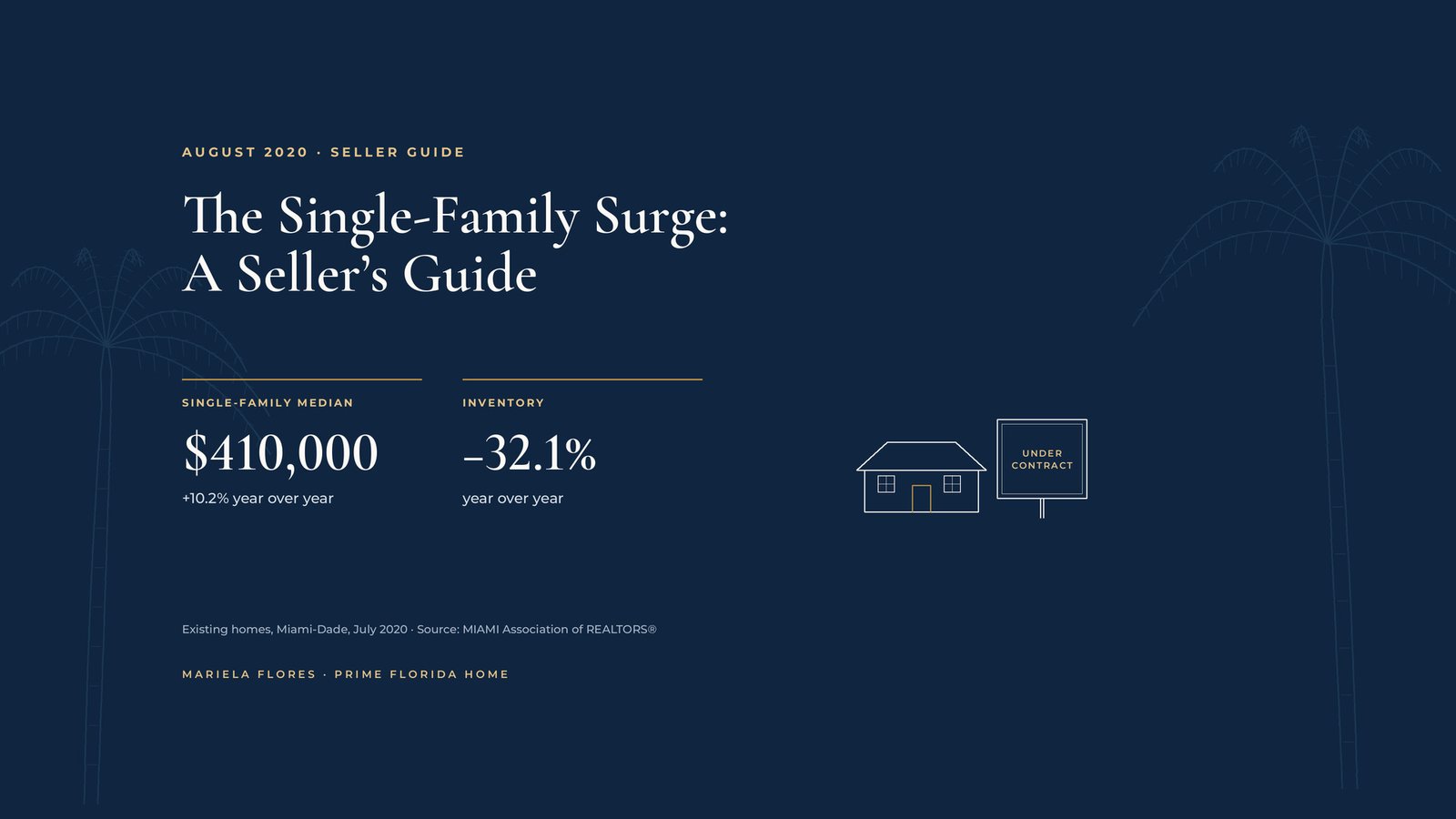
    Miami’s Single-Family Home Surge: What Sellers Should Know in Summer 2020

    If you own a single-family home in Miami-Dade, you may have noticed more “For Sale” signs turning into “Under Contract” signs, or received a call asking whether you would consider selling. The latest numbers confirm what many of us have been seeing: demand for single-family homes is strong, and supply is short. Here is what the data shows and how to sell thoughtfully if the timing is right for you.

    What the July numbers show

    The MIAMI Association of REALTORS® released its July report on August 21. For Miami-Dade single-family homes:

    • Median price: $410,000, up 10.2 percent from $372,000 a year earlier. The Association said single-family prices have risen year over year for 104 consecutive months.
    • New pending sales: 1,692, up 23.8 percent, the second straight month of double-digit gains. Pending sales are an early signal of closings one to two months out.
    • Closed sales: 1,194, down 6 percent, as the market recovers from the spring.
    • Inventory: 4,409 active listings, down 32.1 percent from 6,489, or a 4.3-month supply. The Association considers six to nine months balanced, so this is a seller’s market.
    • Speed: the median single-family home went under contract in 46 days, down from 52 a year earlier.
    • Price received: sellers received a median of 95.9 percent of their original list price.

    Condos tell a different story. The condo median price rose 4.2 percent to $260,000, but supply was 14.2 months, a buyer’s market.

    Why demand has shifted

    The Association pointed to several reasons: pent-up demand from the spring, historically low mortgage rates, and buyers relocating from the Northeast. MIAMI Chairman Jorge L. Guerra Jr. said the surge in pending sales should lead to a significant increase in closed sales in the next couple of months.

    Rates are a big part of it. Freddie Mac’s average 30-year fixed rate was 2.99 percent on August 20, compared with 3.55 percent a year earlier. The Mortgage Bankers Association reported on August 19 that its purchase index was 27 percent higher than in the same week of 2019.

    A seller’s market still needs a plan

    Low inventory gives sellers an advantage, but it does not mean any price will work. Buyers are still careful, and appraisals still matter. Here is how I would approach it.

    Price with recent sales, not hopes. In a fast market, the most recent closed sales and pending sales nearby tell the story. Pricing well can bring several interested buyers. Overpricing can mean a longer wait and a lower final price.

    Think about the appraisal. If a buyer is financing, the lender will order an appraisal. If an offer is well above recent sales, ask how the buyer would handle a low appraisal, for example with extra cash.

    Compare offers on more than price. Look at the financing type, the size of the deposit, the inspection period, the closing date, and the buyer’s flexibility. A slightly lower offer with strong terms can be the better choice.

    Prepare the home. Simple repairs, fresh paint, a clean yard, and good photos still matter. A video tour and a floor plan help buyers who want to see a home virtually first.

    Gather documents early. Have your permits, insurance information, wind mitigation report, any HOA documents, and records of recent updates ready. They help buyers and their lenders move quickly.

    Showings with care

    Some sellers are comfortable with visits; others are not. We can start with virtual tours and limit in-person showings to serious, pre-approved buyers, with clear guidelines that follow the public health guidance in effect at the time. Your comfort sets the rules.

    Where will you go next?

    This is the question I ask every seller. If you sell a single-family home in this market, you may also be buying in it. Before you list, think about:

    • Your next home. Will you buy, rent, or move in with family for a while? Can you negotiate a later closing or a short rent-back?
    • Your taxes. If you have a homestead exemption, your Save Our Homes benefit may be portable to a new Florida homestead within the rules. Ask the Property Appraiser’s office or a tax professional how it applies to you.
    • Your timing. A sale and a purchase can be coordinated, but it takes planning.

    If you are not ready

    Calls from buyers or investors can feel flattering, but there is no need to rush. Knowing your home’s value is useful either way, and I am happy to share a no-obligation review of recent sales near you.

    A calm next step

    Every seller’s situation is different. If you are wondering whether this is your moment, let’s look at your numbers together, by phone, video, or in person with care, with no pressure.

    You can reach me at (305) 409-2815 or mflores@primefloridahome.com.

    Warmly,
    Mariela

    Restored to our archive in 2026, reflecting the market as of August 2020

  • Miami Real Estate in 2019: A Year-End Look Back and the New 2020 Loan Limits

    Miami Real Estate in 2019: A Year-End Look Back and the New 2020 Loan Limits

    As 2019 comes to a close, I want to take a calm look back at what happened in our market this year and share a few numbers that will matter if you plan to buy, sell, or refinance in 2020.

    Rates: the biggest story of the year

    At the start of the year, Freddie Mac’s average 30-year fixed mortgage rate was 4.51 percent. By September 5, it had fallen to 3.49 percent, the lowest average of the year. In this week’s survey, it was 3.73 percent.

    The Federal Reserve lowered its target range for the federal funds rate three times this year: on July 31, September 18, and October 30. After the October cut, the range stood at 1-1/2 to 1-3/4 percent.

    On a $300,000, 30-year loan, the difference between 4.51 percent and 3.73 percent is about $136 a month in principal and interest. That is real breathing room for many households.

    Our market: steady prices, fewer listings

    The MIAMI Association of REALTORS® released its November report on December 19. Here are the highlights for Miami-Dade:

    • Single-family homes: the median price rose 2.8 percent to $365,000. The Association said single-family prices have risen for 96 consecutive months.
    • Condos: the median price rose 6.5 percent to $245,000.
    • Sales: total sales were 2,033, down a slight 0.6 percent. The Association said a lack of inventory at lower price points contributed. Pending sales were up for both property types, and have increased in eight of the last 10 months.
    • Inventory: single-family listings fell 8 percent to 6,526, about a 6-month supply. Condo listings fell 4.9 percent to 15,369, a 13.2-month supply, which the Association still considers a buyer’s market.
    • Cash: 35.1 percent of all closed sales were cash, compared with 36.9 percent a year earlier.

    Compared with February, when condo supply was 14.5 months, the condo market has tightened a bit, though buyers still have plenty of choices.

    Financing changes this year

    A few other changes from 2019 will carry into the new year:

    • FHA condo rules. New FHA rules that took effect October 15 allow single-unit approvals in some buildings that are not FHA-approved. In November, the Association reported 13 FHA-approved buildings out of 9,307 in Miami-Dade and Broward.
    • Private flood insurance. Since July 1, regulated lenders must accept private flood policies that meet the legal definition of “private flood insurance.”
    • Assignment of benefits reform. Florida’s new law on insurance assignment agreements took effect July 1.

    The 2020 loan limits

    Two sets of loan limits change on January 1, 2020:

    • Conforming loans (Fannie Mae and Freddie Mac): the Federal Housing Finance Agency raised the baseline limit for a one-unit home to $510,400, up from $484,350 in 2019. That increase reflects a 5.38 percent rise in home prices. In high-cost areas, the ceiling is $765,600.
    • FHA loans: for Miami-Dade County, the 2020 FHA limit for a one-unit home is $373,750, according to HUD’s 2020 limits. Nationally, the FHA floor is $331,760 and the ceiling is $765,600.

    What does this mean in practice? If you are buying a single-family home near the Miami-Dade median, both FHA and conforming loans can cover it with room to spare. Loans above the conforming limit are often called “jumbo” loans and may have different down payment and credit requirements.

    Planning for 2020

    Here is how I would think about the new year:

    • If you are buying: get pre-approved early, and compare a few loan types. With rates well below where they started 2019, your budget may go further than you expected.
    • If you are selling a single-family home: inventory has been falling, which works in your favor. Pricing with recent sales in mind still matters.
    • If you are selling a condo: buyers still have choices, so preparation and realistic pricing remain key. Find out whether your building is FHA-approved or could support a single-unit approval.
    • If you own a home: review your homestead exemption, your insurance renewals, and whether a refinance still makes sense.

    No one can promise where rates or prices will go in 2020. But knowing your numbers puts you in a calm, strong position.

    Thank you for reading and for trusting me with your questions this year. I wish you and your family a joyful holiday season and a healthy new year. If I can help you plan your next step, I am here, with no pressure.

    You can reach me at (305) 409-2815 or mflores@primefloridahome.com.

    Warmly,
    Mariela

    Restored to our archive in 2026, reflecting the market as of December 2019

  • Opportunity Zones in Miami-Dade: What Homeowners and Buyers Should Know in 2019

    Opportunity Zones in Miami-Dade: What Homeowners and Buyers Should Know in 2019

    “Opportunity Zone” has become one of the most talked-about phrases in Miami real estate over the past year. You may have seen it in a listing description or heard it at a neighborhood meeting. Here is a plain-language look at what the program is, where the zones are in Miami-Dade, and what it does and does not mean if you own or want to buy a home.

    What an Opportunity Zone is

    Opportunity Zones were created by the 2017 federal tax law to encourage long-term private investment in lower-income census tracts. Governors nominated tracts, and the U.S. Treasury certified them. According to the IRS, the first zones were designated on April 9, 2018.

    To qualify, a census tract generally needed a poverty rate of at least 20 percent or a median family income no higher than 80 percent of the area’s median.

    Where the zones are in Miami-Dade

    In April 2018, Florida recommended 427 census tracts statewide. Of those, 68 were in Miami-Dade and Monroe counties. Local reporting has listed areas that include parts of Overtown, Liberty City, Little Haiti, Opa-locka, Carol City, North Miami, and Aventura, among others.

    Zones are drawn by census tract, not by neighborhood name. One side of a street can be in a zone and the other side can be outside it. The IRS points to the official list of designated tracts, and the Census Bureau’s Geocoder can tell you which tract an address is in. If a specific address matters to you, check the tract number rather than relying on a neighborhood label or a listing description.

    How the tax benefit works

    The incentive is for investors who have capital gains, for example from selling stock or a business. According to the IRS:

    • Timing: gains must be invested in a Qualified Opportunity Fund within 180 days.
    • Deferral: tax on that gain can be deferred until the fund investment is sold or December 31, 2026, whichever comes first.
    • Reduction: if the investment is held longer than five years, 10 percent of the deferred gain is excluded; longer than seven years, 15 percent.
    • Long-term benefit: if the investment is held at least 10 years, the investor is eligible for an increase in basis equal to its fair market value on the date it is sold.

    In April 2019, the Treasury Department released a second set of proposed regulations. Treasury said the guidance makes it easier for funds to meet the requirement that 90 percent of their assets be invested in Opportunity Zones, expands the “working capital” safe harbors for projects under development, and clarifies what counts as qualified business property.

    What it means if you are buying a home

    This is the part I want to be very clear about. Buying a home to live in, inside a zone, is not by itself an Opportunity Zone investment. The tax benefits are tied to investing capital gains through a Qualified Opportunity Fund, and the rules about property improvements are detailed. If a listing mentions “Opportunity Zone,” treat it as information about the census tract, not a promise of a tax break for you.

    When you compare homes, the same fundamentals apply anywhere: the condition of the home, its flood zone and insurance costs, property taxes, association rules, and the commute and services that matter to you. If an investment angle is part of your plan, please talk with a tax professional before you sign anything.

    What it means if you already own a home in a zone

    Some owners have received calls or letters from investors. Before you respond to any offer, I suggest:

    • Learn your home’s value from recent nearby sales. An unsolicited offer may or may not reflect the market.
    • Remember your homestead benefits. Moving can change your property tax picture, so look at the full cost of your next home.
    • Take your time. A good offer will still be good after you have reviewed it with someone you trust.

    Different views in the community

    Residents and community leaders have shared mixed feelings. Some hope the program brings jobs and investment; others have raised concerns about rising costs and displacement. Both views are part of the conversation, and it is too early to know how the program will change any particular area.

    A practical next step

    If you own property in Miami-Dade and want to understand what a zone designation means for your plans, or if you are buying and want help evaluating a home, I am happy to talk it through, with no pressure.

    You can reach me at (305) 409-2815 or mflores@primefloridahome.com.

    Warmly,
    Mariela

    Restored to our archive in 2026, reflecting the market as of May 2019

  • Selling a Condo in Miami-Dade’s Buyer’s Market: A Spring 2019 Guide

    Selling a Condo in Miami-Dade’s Buyer’s Market: A Spring 2019 Guide

    If you own a condominium in Miami-Dade and you are thinking about selling this spring, you have probably heard that condos are a “buyer’s market.” That is true, and it is also not the whole story. The latest numbers show condo prices still rising and some price ranges selling briskly. Here is what the data says and how to prepare a condo sale that stands out.

    What February’s numbers show for condos

    The MIAMI Association of REALTORS® released its February report this week. For existing condos in Miami-Dade:

    • Sales: 934 closings, down 5.1 percent from 984 a year earlier.
    • Median price: $250,000, up 8.7 percent from $230,000.
    • Inventory: 16,583 active listings, up 4.2 percent, or 14.5 months of supply. The Association considers six to nine months a balanced market, so condos remain a buyer’s market.
    • Time and price: the median condo went under contract in 83 days, the same as a year earlier, and sellers received a median of 92.6 percent of their original list price.

    There is good news inside those numbers. Condo sales between $300,000 and $600,000 rose 15.9 percent, from 194 to 225. And while total new condo listings fell 7.1 percent, the Association said the growth in inventory has been in condos above $300,000.

    Why condos are a different market

    Two things set condos apart here.

    Cash matters more. In February, 54.7 percent of condo closings were cash, compared with 22.7 percent of single-family sales.

    Financing is harder. The Association continues to report that only 12 of 9,307 condominium buildings in Miami-Dade and Broward counties are approved for FHA loans. When a building cannot be financed with the loans many first-time buyers use, the pool of possible buyers shrinks.

    Mortgage rates have eased since the fall, which helps. Freddie Mac’s average 30-year fixed rate was 4.28 percent in its March 21 survey, down from 4.94 percent in mid-November.

    Price with the competition in mind

    With more than a year’s worth of condos on the market, buyers can compare. I recommend looking closely at:

    • Recent sales in your own building and nearby buildings, not just active listings. Listings show what sellers hope for; closed sales show what buyers paid.
    • Your price range. A unit under $300,000 competes in a tighter segment than one above it.
    • What buyers will pay each month. Association fees, insurance, and taxes are part of a buyer’s budget. A higher monthly fee can affect what buyers offer.

    Sellers who start close to the market usually spend less time waiting. With sellers receiving about 92.6 percent of original list price, a realistic first price is your best negotiating tool.

    Get the association documents ready early

    Florida law gives a condo buyer the right to receive, at the seller’s expense, current copies of the declaration of condominium, the association’s articles of incorporation, bylaws and rules, the year-end financial information, and the “Frequently Asked Questions and Answers” document. A buyer who asks for them in writing can cancel the contract within 3 business days after receiving them.

    That is why I ask condo sellers to request these documents from the association before we list. When a buyer can review them right away, the contract is less likely to stall. It also helps to know in advance:

    • Whether any special assessments are planned or underway
    • The current monthly fee and what it covers
    • The building’s insurance, including wind and flood coverage
    • Rules on leasing, pets, and move-in procedures
    • Whether the association must approve buyers, and how long that takes

    Make the unit easy to say yes to

    Condition matters more when buyers have choices. Simple steps make a difference: fresh paint in neutral colors, working appliances and air conditioning, good lighting, and a clean balcony. If you have impact windows or recent upgrades, keep the permits and receipts handy.

    Think about financing, too. If your building is not FHA-approved, conventional and cash buyers will be your main audience. Ask a lender early whether your building has any issues, such as litigation or a high share of rentals, that could make conventional financing harder.

    A calm plan

    A buyer’s market does not mean you cannot sell. It means preparation and pricing matter more. If you are thinking about selling your condo this year, I am happy to review recent sales in your building and walk through the documents with you, with no pressure.

    You can reach me at (305) 409-2815 or mflores@primefloridahome.com.

    Warmly,
    Mariela

    Restored to our archive in 2026, reflecting the market as of March 2019

  • Thinking of Selling Your Miami-Dade Home in 2019? What 2018 Taught Us

    Thinking of Selling Your Miami-Dade Home in 2019? What 2018 Taught Us

    The last week of the year is a quiet time in real estate, and it is a good moment to plan. If you are thinking about selling your Miami-Dade home in 2019, here is what this year’s market tells us, what changes on January 1, and how to get ready without rushing.

    Where the market stands

    The latest report from the MIAMI Association of REALTORS®, covering November, shows that total sales in Miami-Dade rose 7 percent from a year earlier. It was the fifth straight month of year-over-year gains.

    • Single-family homes: Sales rose 5.2 percent, from 947 to 996. The median price rose 5.2 percent, from $330,000 to $355,000, the 84th consecutive month of year-over-year gains.
    • Existing condos: Sales rose 8.8 percent, from 965 to 1,050. The median price was unchanged at $230,000.

    Through November, the county recorded 11,920 single-family sales, up 1.6 percent from the same period in 2017, and 12,793 condo sales, up 6.8 percent.

    Chairman George C. Jalil credited increased inventory and sellers “becoming more reasonable with their prices” for the rise in sales. I think that is the most useful lesson of 2018 for anyone planning to sell.

    More competition, especially at higher prices

    Single-family inventory rose 14.5 percent, from 6,191 listings to 7,091, which works out to 6.6 months of supply. The Association calls that a balanced market. Condo inventory rose 4.4 percent to 16,162 listings, or 13.9 months of supply, a buyer’s market. The Association said the increase is in condos above $300,000 and single-family homes above $600,000.

    Homes are still moving at a reasonable pace. The median time to contract was 48 days for single-family homes, down from 55 a year earlier, and 64 days for condos, down from 80. Sellers received a median of 95.2 percent of their original list price for single-family homes and 94.1 percent for condos.

    What does that mean in plain terms? Buyers have more choices than they did a year or two ago, especially above $600,000. Homes that are priced right and show well still sell in reasonable time. Homes that start too high tend to sit.

    Mortgage rates eased in December

    Rates shape what buyers can pay. Freddie Mac’s average 30-year fixed rate peaked at 4.94 percent in mid-November and fell to 4.55 percent for the week ending December 27. The Federal Reserve raised its benchmark rate on December 19, to a range of 2.25 to 2.5 percent, its fourth increase this year, but mortgage rates moved lower anyway. Nobody can predict where they will go next, but buyers are entering the new year with somewhat better rates than they had a month ago.

    What changes on January 1

    • The 10 percent cap continues. Voters approved Amendment 2 in November, so the cap on assessment increases for non-homestead property continues after January 1. If you are selling a rental or second home, buyers may ask how that cap works.
    • Homestead renewals are in the mail. The Property Appraiser is mailing about 408,000 homestead renewal forms and about 15,000 applications on December 28. If you sell your homestead in 2019 and buy another Florida home, ask about portability, which can transfer some of your Save Our Homes benefit to your next homestead.
    • Flood insurance runs through May 31. On December 21, the President signed an extension of the National Flood Insurance Program through May 31, 2019. A partial federal government shutdown began the next day, and its effect on new flood policies was not clear at first. If your buyer will need flood insurance, start the quote early.

    A calm plan for a 2019 sale

    • Start with a pricing conversation. Look at recent sales in your price range and property type, not countywide headlines.
    • Take care of the easy repairs. Fix small things, freshen paint where needed, and make sure the roof, air conditioning, and windows are in good shape.
    • Gather your documents. Have your permits, any wind mitigation report, insurance information, and, for condos, association documents and budgets ready.
    • Be open about what you know. Florida sellers must disclose known facts that materially affect a home’s value and are not readily visible.
    • Think about taxes. Married couples can generally exclude up to $500,000 of gain, and single filers up to $250,000, on a home they have lived in for two of the last five years. Please check your own situation with a tax professional.

    Let’s plan your next step

    If 2019 might be your year to sell, I am happy to sit down with you in January and look at the numbers for your home, with no pressure and no rush. Thank you for reading this year, and I wish you and your family a happy and healthy new year.

    You can reach me at (305) 409-2815 or mflores@primefloridahome.com.

    Warmly,
    Mariela

    Restored to our archive in 2026, reflecting the market as of December 2018