
The most useful market report we have this month arrived on October 20, when the MIAMI Association of REALTORS® released its September 2017 figures. I want to walk through them carefully, because a storm month can be easy to misread. Closed sales fell sharply. Prices did not. And single-family homes and condominiums are still telling two different stories.
One dating note, because it matters: these are September results, published in the second half of October. The October monthly report will not be out until November, so I am not going to guess at this month’s closings.
Sales slowed because closings did
Existing single-family sales in Miami-Dade fell 35.8 percent year over year in September, from 1,066 to 684. Existing condominium sales fell 24.4 percent, from 1,064 to 804. Total existing residential sales were 1,488, down 30.1 percent from 2,130 a year earlier. Sales volume for those properties was $631.1 million, a figure that does not include Miami’s new-construction condominium market.
The Association attributed the drop to Hurricane Irma, which stalled hundreds of sales while people cleared tree debris and rescheduled inspections and appraisals. Irma made landfall as a Category 4 storm in the Lower Florida Keys on September 10 and brought Category 1 winds to Miami, with limited damage, mostly fallen trees. Most power and internet in Miami were not fully restored until September 19. By October 10, the county had collected more than one million cubic yards of debris.
Christopher Zoller, the Association’s 2017 chairman, said that after Irma, federally backed lenders required new appraisals on Miami properties already under contract, and that many buyers and sellers had delays getting crews, inspectors, and appraisers out. He also said Miami homes continue being purchased and that the market should return to pre-Irma sales levels as those stalled transactions finalize. That is the context I would put around the closing numbers: they are a snapshot of a disrupted month, not a sudden change in whether people want to live here.
New listings were disrupted too. New single-family listings fell 44.7 percent year over year, to 967 from 1,749, and new condominium listings fell 34.3 percent, to 1,429 from 2,175.
Prices kept rising
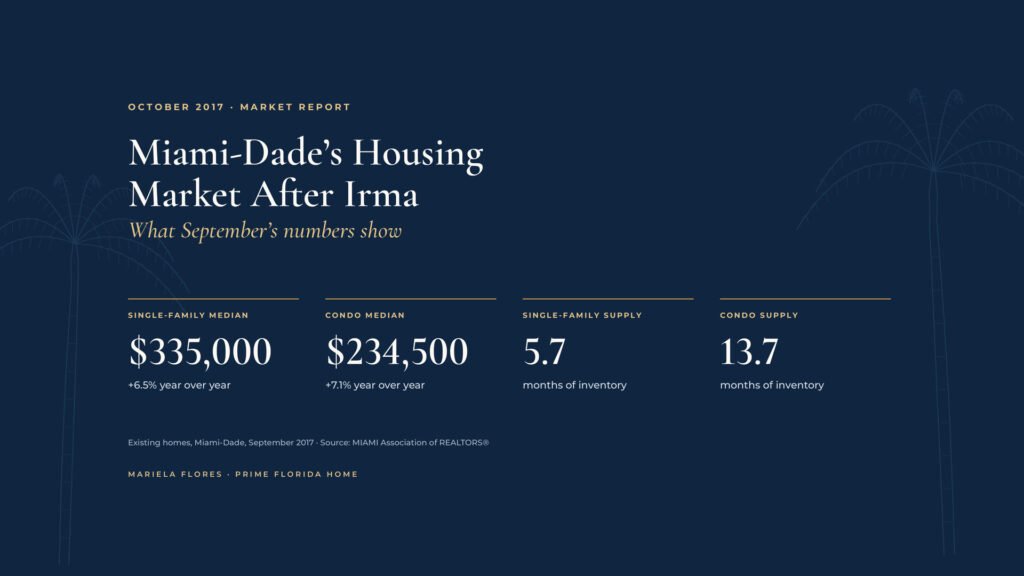
The median price for an existing single-family home in Miami-Dade was $335,000 in September, up 6.5 percent from $314,500 a year earlier. That marked 70 consecutive months of single-family price increases, a streak of nearly six years. The median existing-condominium price was $234,500, up 7.1 percent from $219,000, with condo prices up in 73 of the last 76 months.
Homes that did close also sold fairly close to list. Single-family sellers received a median of 95.1 percent of the original asking price, and condominium sellers received 93.2 percent. The median time from listing to contract was 41 days for single-family homes, down from 45 days a year earlier, and 93 days for condominiums, unchanged.
Distressed sales kept fading into the background. They accounted for 9.1 percent of closed residential sales in September, including bank-owned properties and short sales, compared with 16.4 percent in September 2016 and 70 percent in 2009.
Two markets: single-family and condominium
Inventory is where the two sides of the market look least alike. Active single-family listings fell 4.8 percent year over year, from 6,368 to 6,060. That equaled 5.7 months of supply, which the Association classifies as a seller’s market. Active condominium listings rose 5.2 percent, from 14,106 to 14,834, or 13.7 months of supply, which it classifies as a buyer’s market. The Association defines a balanced market as six to nine months of supply. Total active listings were 20,894, up 2.1 percent from 20,474 a year earlier, and still about 60 percent below 2008 levels.
Existing condominiums are also competing with a large new-construction market, and financing remains a constraint. Of 9,307 condominium buildings in Miami-Dade and Broward counties, only 12 were approved for Federal Housing Administration loans, down from 29 a year earlier, according to the Florida Department of Business and Professional Regulation and the FHA, as cited by the Association.
Cash buyers remain a much larger share of this market than they are nationally. Cash transactions were 43.5 percent of September closings in Miami-Dade, more than double the national figure of 20 percent. The share was 57.6 percent of condominium closings and 27.0 percent of single-family closings. The Association links the high condominium cash share in part to the lack of financing approvals for many buildings.
What this means as the season begins
For buyers, September’s lower closing count should not be read as a sudden opening of the floodgates, especially in single-family homes, where supply remains on the seller’s side of balanced. It may mean you will see some delayed listings come to market as cleanup finishes, and it does mean you should leave room in a contract for inspections and a careful appraisal.
For sellers, the price trend and the list-price ratios suggest that a well-prepared home, priced in line with recent comparables, still has a path to a solid result. Condominium sellers should be more precise, because buyers have more existing and new inventory to compare.
Mortgage rates have stayed relatively modest this month. Freddie Mac’s weekly survey put the average 30-year fixed rate, with 0.5 points, at 3.85 percent, 3.91 percent, 3.88 percent, and 3.94 percent in the four weeks ending October 5, 12, 19, and 26. The 15-year fixed rate was 3.15 percent, 3.21 percent, 3.19 percent, and 3.25 percent. Those are national averages, not a quote, but they are the backdrop against which local buyers are shopping.
If you would like to talk about what these figures mean for a particular property or a search you have underway, I am here to walk through them with you.
You can reach me at (305) 409-2815 or mflores@primefloridahome.com.
Warmly,
Mariela
Restored to our archive in 2026, reflecting the market as of October 2017