
Last Wednesday, the Federal Reserve cut interest rates for the first time in four years, and my phone has been busy since. The most common question: “Does this mean mortgage rates just dropped?” The honest answer is “partly, and mostly already.” Here’s what the Fed did, what it does and doesn’t mean for your mortgage, and a look at recent numbers for Miami-Dade and our own corner of the northern Tamiami area, zip code 33182.
What the Fed did
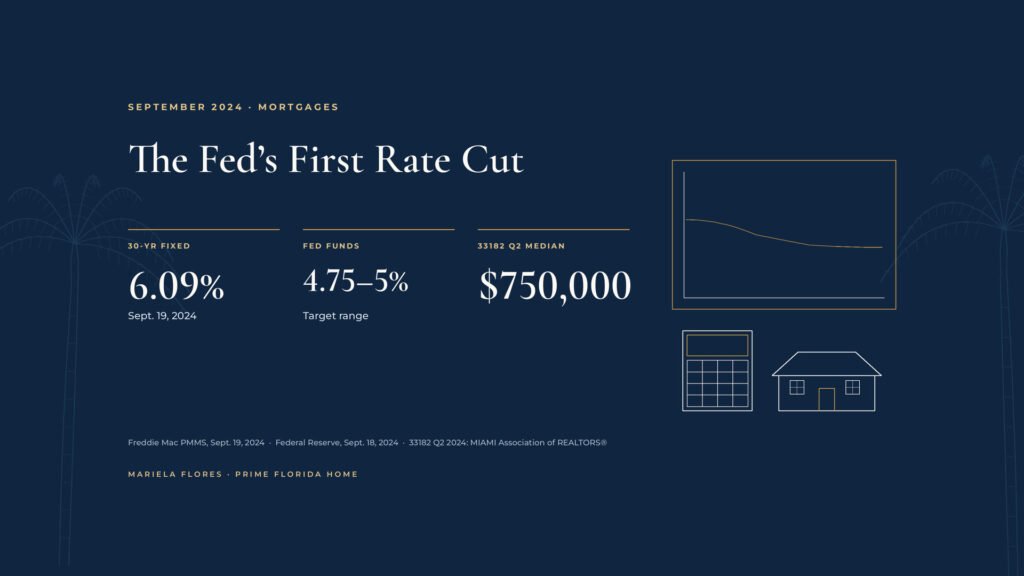
On September 18, the Federal Reserve announced it was lowering its federal funds target range by half a percentage point, to 4.75 to 5 percent. In its statement, the Fed said it had gained greater confidence that inflation is moving sustainably toward 2 percent. The decision wasn’t unanimous: one Fed governor, Michelle Bowman, voted for a smaller quarter-point cut.
MIAMI REALTORS described it as the first rate cut in four years.
What it means for mortgage rates
Here’s the part that surprises people: the Fed doesn’t set mortgage rates. The federal funds rate is a short-term rate that banks charge each other overnight. A 30-year mortgage rate tends to follow longer-term borrowing costs and investors’ expectations about the economy and inflation.
Because markets expected this cut, much of it showed up in mortgage rates before the Fed acted. Look at Freddie Mac’s weekly survey of the 30-year fixed rate:
- May 2: 7.22 percent, the highest weekly average so far this year.
- August 22: 6.46 percent.
- September 19: 6.09 percent, the day after the Fed’s announcement.
So rates had already come down more than a full point from their spring high.
What that means in dollars
Here’s a simple illustration using the standard loan formula, for principal and interest only on a $500,000, 30-year fixed loan:
- At 7.22 percent: about $3,401 a month.
- At 6.09 percent: about $3,027 a month.
That’s a difference of about $374 a month. Your actual rate depends on your credit, down payment, loan type, and the day you lock, and taxes and insurance come on top.
What it doesn’t mean
- Rates won’t fall in a straight line. Mortgage rates can rise and fall from week to week, even when the Fed is cutting.
- Waiting has trade-offs. If rates keep easing, more buyers may come back to the market, and that can mean more competition.
- A cut doesn’t change your budget overnight. A comfortable monthly payment is still the right starting point.
If you’re thinking about buying, my suggestion is to get pre-approved now so you know your numbers, and ask your lender how rate locks and float-down options work. If you bought in the past couple of years at a higher rate, it’s worth a quick conversation with your lender about whether refinancing would make sense for you, keeping closing costs in mind.
Miami-Dade in August
MIAMI REALTORS reported on September 19 that Miami-Dade single-family home sales rose 1.7 percent in August to 964, and the median price rose 3.2 percent to $640,000, the 153rd consecutive month of year-over-year gains. Inventory rose 36.6 percent to 4,183 homes, or 4.7 months of supply. Homes went under contract in a median of 27 days and sold for 96.8 percent of original list price.
On the condo side, the median price was $415,000, down 0.2 percent, and sales fell 15.6 percent to 1,038, which MIAMI REALTORS attributed to a lack of condo financing and inventory at key price points. Condo inventory rose 57.6 percent to 10,094, or 9.5 months of supply. Cash purchases made up 32.9 percent of all closed sales.
A closer look at 33182
Because so many of my clients live in or near 33182, I looked at MIAMI REALTORS’ zip code report for the second quarter of 2024, released July 23. For single-family homes in 33182, from April through June:
- Closed sales: 17, up 54.5 percent from a year earlier.
- Median sale price: $750,000, up 18.9 percent.
- Percent of original list price received: 97.5 percent.
- Median days to contract: 16.
- New listings: 14, with 12 active listings at the end of the quarter.
- Months of supply: 2.5.
For comparison, the county’s single-family median for the quarter was $650,000, up 6.6 percent, on 3,133 sales.
One important caution: 17 sales is a small number, and a few higher- or lower-priced homes can swing the median quite a bit from one quarter to the next. So I’d treat these as a snapshot, not a trend. If you own a home in 33182 and want a clearer picture, a comparative market analysis based on recent sales of homes like yours is much more reliable than any single quarter’s median.
The bottom line
The Fed’s cut is good news, but much of it was already reflected in mortgage rates. The best move is still the calm one: know your numbers, talk with a lender, and decide based on your own timeline. If you’d like to run numbers together or see what your home might be worth today, I’m happy to help, with no pressure.
You can reach me at (305) 409-2815 or mflores@primefloridahome.com.
Warmly,
Mariela
Restored to our archive in 2026, reflecting the market as of September 2024