Category: Miami Neighborhoods

Neighborhood information for home buyers and sellers across Miami-Dade.

  • Tamiami 33182 in 2025: A Year-End Look at Single-Family Home Sales

    Tamiami 33182 in 2025: A Year-End Look at Single-Family Home Sales

    Last October, I shared the second-quarter numbers for zip code 33182 in northern Tamiami. Now the full picture for 2025 is in. On January 16, MIAMI REALTORS released its fourth-quarter and full-year reports by zip code, so here’s a look at how single-family homes in zip code 33182 did last year, how that compares with the county, and an honest reminder about small numbers. All of the figures below come from those single-family reports, so they don’t include condos or townhouses.

    Zip code 33182: the fourth quarter

    For October through December 2025, MIAMI’s report shows the following for single-family homes in zip code 33182:

    MeasureQ4 2025Change from Q4 2024
    Closed sales15Up 50 percent
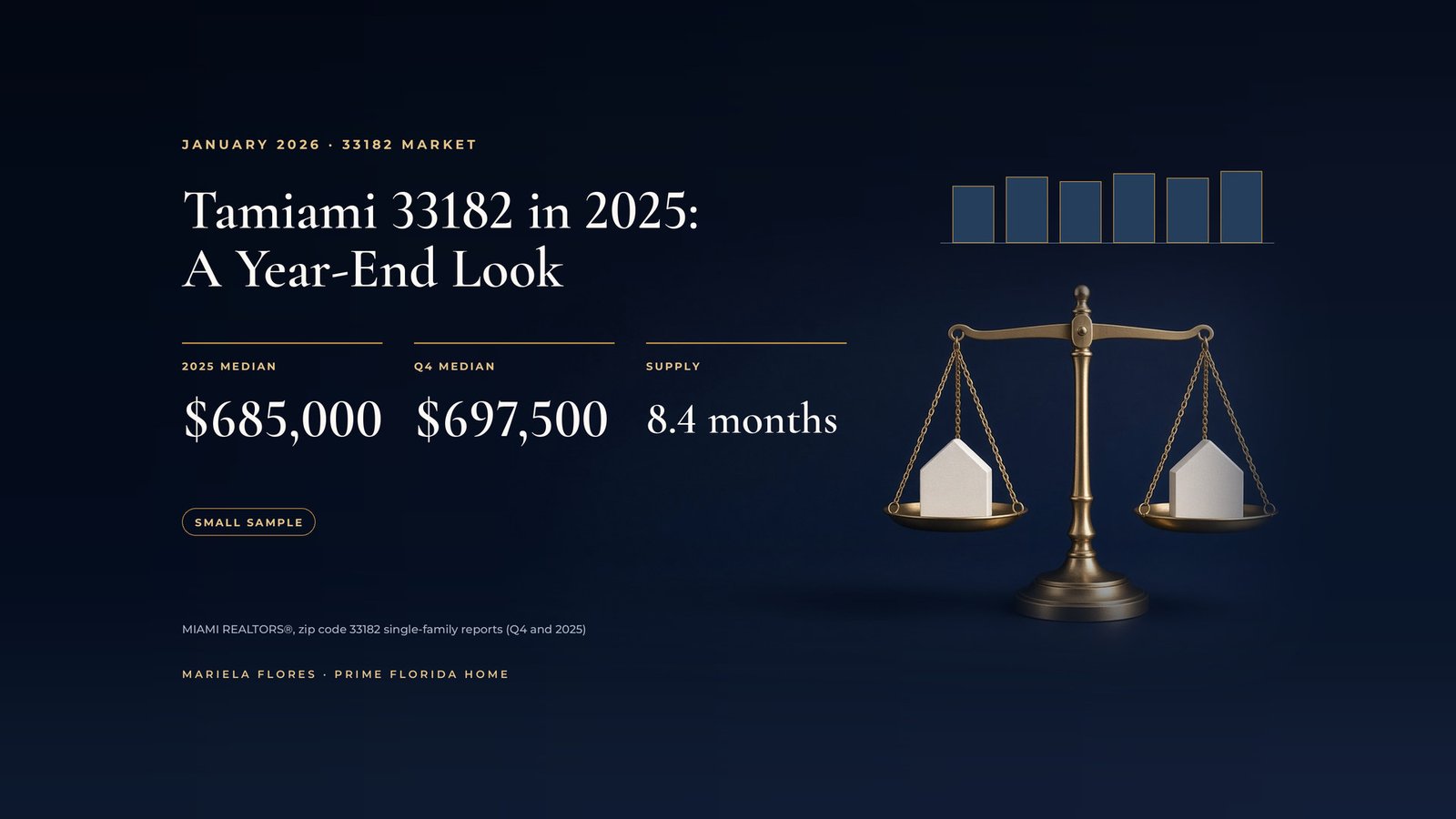
    Median sale price$697,500Up 8.6 percent
    Median percent of original list price received96.2 percentDown 1.8 percent
    Median days to contract32Up 28 percent
    New listings23Up 76.9 percent
    Active inventory (end of quarter)35Up 66.7 percent
    Months of supply8.4Up 64.7 percent

    Zip code 33182: all of 2025

    For the full year, the report shows:

    Measure2025Change from 2024
    Closed sales50Up 2 percent
    Median sale price$685,000Down 7.7 percent
    Median percent of original list price received96.6 percentDown 1 percent
    Median days to contract32Up 3.2 percent
    New listings107Up 32.1 percent
    Months of supply (year-end)8.4Up 64.7 percent

    How the county compares

    The same reports include Miami-Dade County as a whole. For all county single-family homes in 2025, there were 10,210 sales, down 4.9 percent, with a median price of $665,000, up 2.3 percent. The county’s median time to contract was 53 days, the median percent of original list price received was 94.8 percent, and there were 6.2 months of supply at year-end.

    In the fourth quarter alone, the county recorded 2,501 single-family sales, up 5.3 percent, with a median price of $670,000, up 0.8 percent, a median of 94.3 percent of original list price received, and a median of 53 days to contract.

    A small-sample caution

    Please read the 33182 numbers with care. Fifty sales in a year, and 15 in a quarter, is a small sample, and it’s too few to call a trend. One or two sales at an unusually high or low price can move the median noticeably, and percentage changes can look dramatic when the starting number is small. For example, a 50 percent rise in quarterly sales here means about five more homes sold, and the fourth-quarter median rose while the full-year median fell. Both are true, and neither tells the whole story alone.

    So I treat zip code data as one clue, not a conclusion. Recent sales of similar homes, condition, lot, and updates matter much more for any one property.

    What the 2025 numbers show

    With that caution in mind, here is what the report shows for 2025:

    • More listings. New listings rose about a third for the year, and active inventory at year-end was up about two-thirds.
    • More supply than the county. Months of supply at year-end was 8.4 in 33182, compared with 6.2 countywide.
    • Time to contract. The median was 32 days in 33182, both for the year and the fourth quarter, compared with 53 days countywide, and sellers received a median of 96.6 percent of original list price for the year.

    Getting to know the area

    Zip code 33182 covers part of northern Tamiami, including areas such as Belen and Lake Pointe/Imperial Lakes. A few places that help you get your bearings:

    • North Trail Park, a county park at 780 NW 127th Avenue, has a recreation center, a playground, tennis courts, a lighted skate ramp, and a soccer field.
    • Imperial Lake, a planned community at 12301 NW 7th Lane, has 1,257 residential units, according to its management company, with a pool, tennis court, sauna, clubhouse, and security.
    • Schools nearby include Paul W. Bell Middle School at 11800 NW 2nd Street and the Early Childhood Center of Marjory Stoneman Douglas Elementary at 11920 NW 2nd Street. For school assignments, check with Miami-Dade County Public Schools.
    • Dolphin Mall (11401 NW 12th Street) and Florida’s Turnpike are just east.

    What this means for you

    If you’re thinking of selling in 33182:

    • Price with recent, similar sales. With more homes for sale, buyers have choices, and pricing in line with the market helps you stand out.
    • Prepare before you list. Spring is often a busy season, so January and February are good months for repairs and paperwork.
    • Check your homestead and portability. If you’re selling to buy another Florida home, my January 13 post explains how portability may help.

    If you’re thinking of buying:

    • Take your time. More inventory can mean more options and room for inspections and questions.
    • Get pre-approved. An updated conversation with a lender helps you know your budget before you start touring.

    The bottom line

    In 2025, single-family homes in zip code 33182 saw more listings and more supply, with a median time to contract of about a month, all with the caution a small sample deserves. If you’d like a closer look at recent sales on your street or a home you’re considering, I’m happy to put them together for you, with no pressure.

    You can reach me at (305) 409-2815 or mflores@primefloridahome.com.

    Warmly,
    Mariela

    Restored to our archive in 2026, reflecting the market as of January 2026
  • Tamiami 33182 Home Prices in 2025: A Balanced Market Takes Shape in Miami-Dade

    Tamiami 33182 Home Prices in 2025: A Balanced Market Takes Shape in Miami-Dade

    One question I hear often in Tamiami these days is, “Is it a buyer’s market now or a seller’s market?” For single-family homes across Miami-Dade, the most accurate answer this fall is “neither, really.” The market has been moving toward balance. Here’s a look at the latest county numbers and the most recent quarterly data for the 33182 ZIP code, with an important caution about small numbers.

    Miami-Dade: a balanced single-family market

    MIAMI REALTORS released its August 2025 data on September 23. For Miami-Dade single-family homes:

    • Sales: 885, down 8.2 percent from 964 a year earlier.
    • Median price: $655,000, up 2.3 percent from $640,000.
    • Inventory: 5,361 active listings, up 28.2 percent from 4,183.
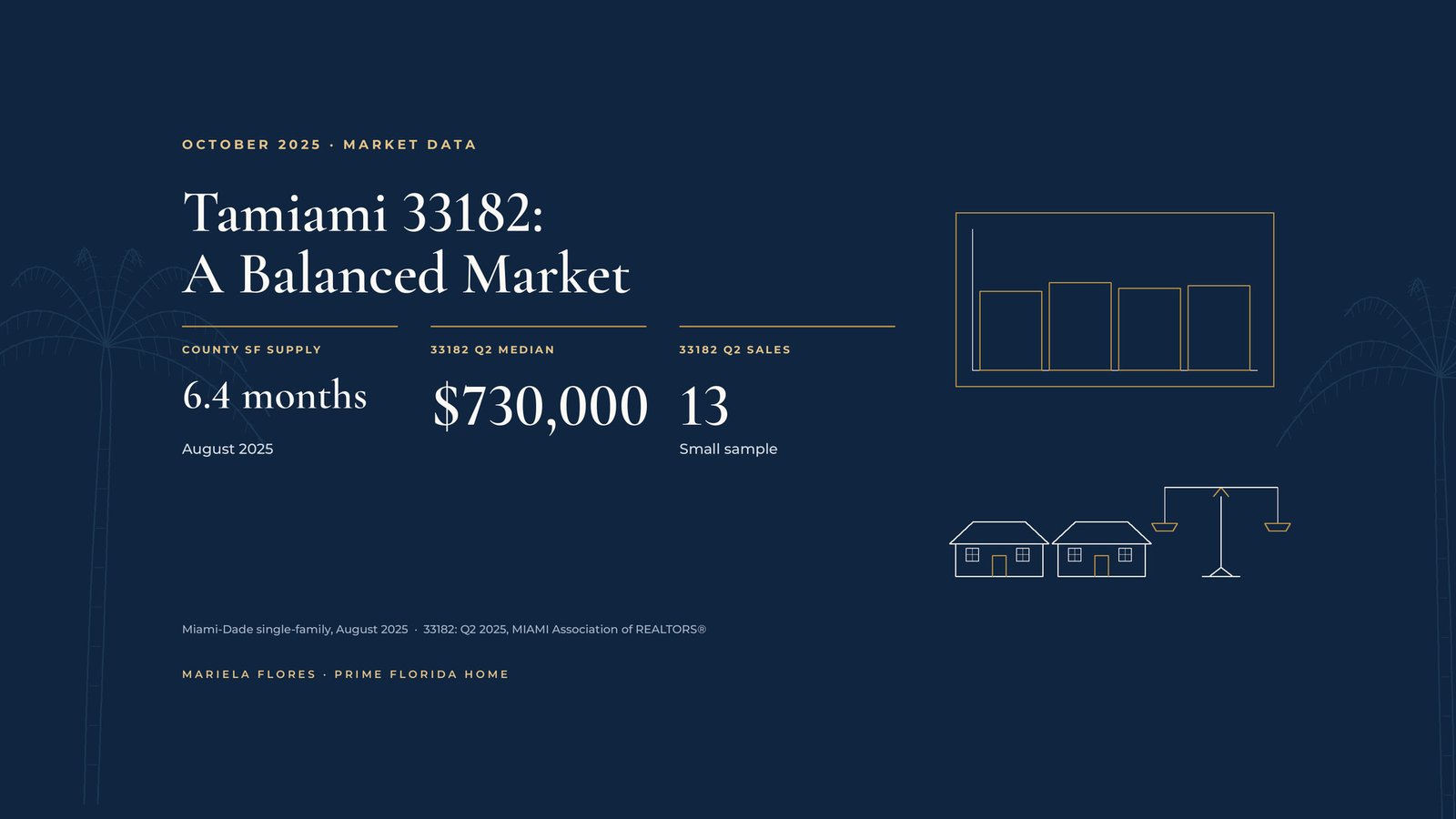
    • Months of supply: 6.4 months, which MIAMI describes as a balanced market. It defines balance as six to nine months of supply.
    • Time to contract: a median of 51 days, up from 27 days a year earlier.
    • Price received: a median of 94 percent of original list price.

    MIAMI summed it up this way: “The market is moving towards balance, which is healthy after the pandemic home-buying craze.”

    Condos are in a different place. Condo inventory reached 14 months of supply, which MIAMI describes as a buyer’s market, and the median condo price slipped 1.2 percent to $410,000.

    33182: second-quarter 2025 data

    MIAMI REALTORS publishes quarterly reports by ZIP code. The most recent, covering the second quarter of 2025 (April through June) and released on July 23, shows the following for single-family homes in 33182:

    MeasureQ2 2025Change from Q2 2024
    Closed sales13Down 23.5 percent
    Median sale price$730,000Down 2.7 percent
    Median percent of original list price received96.7 percent—
    Median days to contract44Up 175 percent
    New listings23Up 64.3 percent
    Active inventory34Up 183.3 percent
    Months of supply9.3—

    For comparison, the county’s single-family figures for the same quarter were 2,791 closed sales, a median price of $675,000, a median of 95.4 percent of original list price received, a median of 44 days to contract, and 6.6 months of supply.

    A small-sample caution

    Please read the 33182 numbers carefully. Thirteen sales in a quarter is a very small sample. A single sale at a much higher or lower price can move the median significantly, and percentage changes can look dramatic when the base is small. Going from 12 active listings to 34 is a large percentage jump, even though it’s 22 more homes. Likewise, a median of 44 days to contract is up 175 percent, yet it matches the county’s median for the same quarter.

    So I’d treat ZIP-level data as one clue, not a conclusion. What these numbers do suggest, together with the county data, is that buyers in the area had more homes to choose from and more time to decide this spring than a year earlier.

    MIAMI’s third-quarter ZIP code report is expected later this month, and I’ll be looking at it closely.

    Rates and the Fed

    On September 17, the Federal Reserve lowered its target range for the federal funds rate by a quarter point, to 4 to 4.25 percent, its first cut of 2025. Mortgage rates don’t follow the Fed directly, but they have eased this year. Freddie Mac’s 30-year fixed rate averaged 6.27 percent on October 16, down from 7.04 percent in mid-January.

    What a balanced market means for you

    If you’re selling:

    • Price with care. In a balanced market, homes priced in line with recent sales tend to attract attention; overpriced ones tend to sit.
    • Expect negotiation. With a median of 94 percent of original list price countywide, many sellers are negotiating. Plan for it.
    • Present your home well. Repairs, clean documents, and a clear story about the home’s updates help buyers feel confident.

    If you’re buying:

    • Take your time. More inventory means more options and often more room for inspections and questions.
    • Negotiate thoughtfully. Requests for repairs or closing-cost help can be reasonable, but a fair offer still matters.
    • Get pre-approved. Rates have eased this year, so it’s worth an updated conversation with a lender.

    The bottom line

    The single-family market in Miami-Dade is finding its balance, and 33182’s latest quarterly numbers point in the same direction, with the caution that a small sample deserves. If you’d like a closer look at recent sales on your street or a home you’re considering, I’m happy to pull them together, with no pressure.

    You can reach me at (305) 409-2815 or mflores@primefloridahome.com.

    Warmly,
    Mariela

    Restored to our archive in 2026, reflecting the market as of October 2025

  • The Fed’s First Rate Cut in Four Years: What It Means for Miami Mortgage Rates, With a Look at 33182

    The Fed’s First Rate Cut in Four Years: What It Means for Miami Mortgage Rates, With a Look at 33182

    Last Wednesday, the Federal Reserve cut interest rates for the first time in four years, and my phone has been busy since. The most common question: “Does this mean mortgage rates just dropped?” The honest answer is “partly, and mostly already.” Here’s what the Fed did, what it does and doesn’t mean for your mortgage, and a look at recent numbers for Miami-Dade and our own corner of the northern Tamiami area, zip code 33182.

    What the Fed did

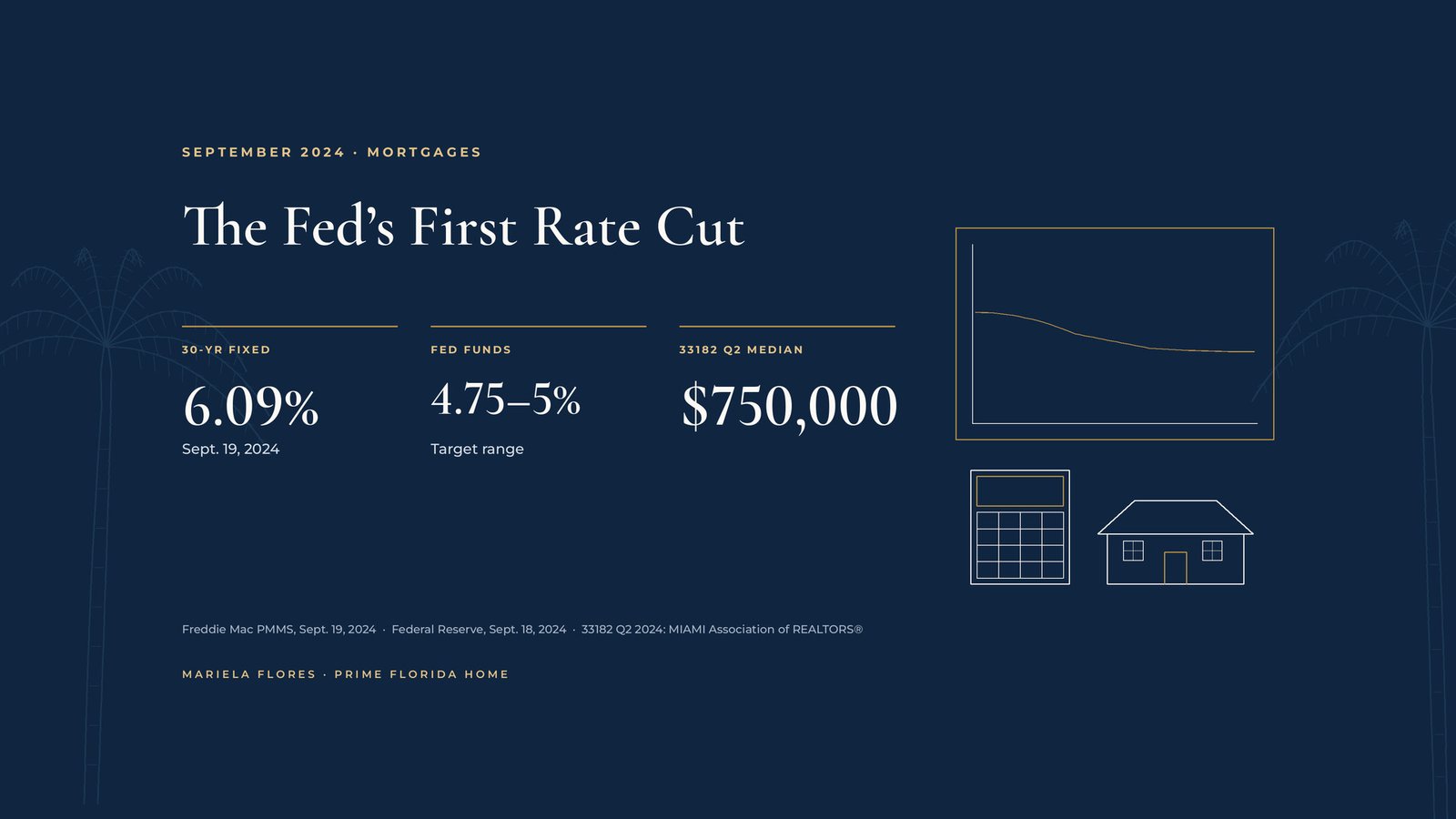
    On September 18, the Federal Reserve announced it was lowering its federal funds target range by half a percentage point, to 4.75 to 5 percent. In its statement, the Fed said it had gained greater confidence that inflation is moving sustainably toward 2 percent. The decision wasn’t unanimous: one Fed governor, Michelle Bowman, voted for a smaller quarter-point cut.

    MIAMI REALTORS described it as the first rate cut in four years.

    What it means for mortgage rates

    Here’s the part that surprises people: the Fed doesn’t set mortgage rates. The federal funds rate is a short-term rate that banks charge each other overnight. A 30-year mortgage rate tends to follow longer-term borrowing costs and investors’ expectations about the economy and inflation.

    Because markets expected this cut, much of it showed up in mortgage rates before the Fed acted. Look at Freddie Mac’s weekly survey of the 30-year fixed rate:

    • May 2: 7.22 percent, the highest weekly average so far this year.
    • August 22: 6.46 percent.
    • September 19: 6.09 percent, the day after the Fed’s announcement.

    So rates had already come down more than a full point from their spring high.

    What that means in dollars

    Here’s a simple illustration using the standard loan formula, for principal and interest only on a $500,000, 30-year fixed loan:

    • At 7.22 percent: about $3,401 a month.
    • At 6.09 percent: about $3,027 a month.

    That’s a difference of about $374 a month. Your actual rate depends on your credit, down payment, loan type, and the day you lock, and taxes and insurance come on top.

    What it doesn’t mean

    • Rates won’t fall in a straight line. Mortgage rates can rise and fall from week to week, even when the Fed is cutting.
    • Waiting has trade-offs. If rates keep easing, more buyers may come back to the market, and that can mean more competition.
    • A cut doesn’t change your budget overnight. A comfortable monthly payment is still the right starting point.

    If you’re thinking about buying, my suggestion is to get pre-approved now so you know your numbers, and ask your lender how rate locks and float-down options work. If you bought in the past couple of years at a higher rate, it’s worth a quick conversation with your lender about whether refinancing would make sense for you, keeping closing costs in mind.

    Miami-Dade in August

    MIAMI REALTORS reported on September 19 that Miami-Dade single-family home sales rose 1.7 percent in August to 964, and the median price rose 3.2 percent to $640,000, the 153rd consecutive month of year-over-year gains. Inventory rose 36.6 percent to 4,183 homes, or 4.7 months of supply. Homes went under contract in a median of 27 days and sold for 96.8 percent of original list price.

    On the condo side, the median price was $415,000, down 0.2 percent, and sales fell 15.6 percent to 1,038, which MIAMI REALTORS attributed to a lack of condo financing and inventory at key price points. Condo inventory rose 57.6 percent to 10,094, or 9.5 months of supply. Cash purchases made up 32.9 percent of all closed sales.

    A closer look at 33182

    Because so many of my clients live in or near 33182, I looked at MIAMI REALTORS’ zip code report for the second quarter of 2024, released July 23. For single-family homes in 33182, from April through June:

    • Closed sales: 17, up 54.5 percent from a year earlier.
    • Median sale price: $750,000, up 18.9 percent.
    • Percent of original list price received: 97.5 percent.
    • Median days to contract: 16.
    • New listings: 14, with 12 active listings at the end of the quarter.
    • Months of supply: 2.5.

    For comparison, the county’s single-family median for the quarter was $650,000, up 6.6 percent, on 3,133 sales.

    One important caution: 17 sales is a small number, and a few higher- or lower-priced homes can swing the median quite a bit from one quarter to the next. So I’d treat these as a snapshot, not a trend. If you own a home in 33182 and want a clearer picture, a comparative market analysis based on recent sales of homes like yours is much more reliable than any single quarter’s median.

    The bottom line

    The Fed’s cut is good news, but much of it was already reflected in mortgage rates. The best move is still the calm one: know your numbers, talk with a lender, and decide based on your own timeline. If you’d like to run numbers together or see what your home might be worth today, I’m happy to help, with no pressure.

    You can reach me at (305) 409-2815 or mflores@primefloridahome.com.

    Warmly,
    Mariela

    Restored to our archive in 2026, reflecting the market as of September 2024

  • Opportunity Zones in Miami-Dade: What Homeowners and Buyers Should Know in 2019

    Opportunity Zones in Miami-Dade: What Homeowners and Buyers Should Know in 2019

    “Opportunity Zone” has become one of the most talked-about phrases in Miami real estate over the past year. You may have seen it in a listing description or heard it at a neighborhood meeting. Here is a plain-language look at what the program is, where the zones are in Miami-Dade, and what it does and does not mean if you own or want to buy a home.

    What an Opportunity Zone is

    Opportunity Zones were created by the 2017 federal tax law to encourage long-term private investment in lower-income census tracts. Governors nominated tracts, and the U.S. Treasury certified them. According to the IRS, the first zones were designated on April 9, 2018.

    To qualify, a census tract generally needed a poverty rate of at least 20 percent or a median family income no higher than 80 percent of the area’s median.

    Where the zones are in Miami-Dade

    In April 2018, Florida recommended 427 census tracts statewide. Of those, 68 were in Miami-Dade and Monroe counties. Local reporting has listed areas that include parts of Overtown, Liberty City, Little Haiti, Opa-locka, Carol City, North Miami, and Aventura, among others.

    Zones are drawn by census tract, not by neighborhood name. One side of a street can be in a zone and the other side can be outside it. The IRS points to the official list of designated tracts, and the Census Bureau’s Geocoder can tell you which tract an address is in. If a specific address matters to you, check the tract number rather than relying on a neighborhood label or a listing description.

    How the tax benefit works

    The incentive is for investors who have capital gains, for example from selling stock or a business. According to the IRS:

    • Timing: gains must be invested in a Qualified Opportunity Fund within 180 days.
    • Deferral: tax on that gain can be deferred until the fund investment is sold or December 31, 2026, whichever comes first.
    • Reduction: if the investment is held longer than five years, 10 percent of the deferred gain is excluded; longer than seven years, 15 percent.
    • Long-term benefit: if the investment is held at least 10 years, the investor is eligible for an increase in basis equal to its fair market value on the date it is sold.

    In April 2019, the Treasury Department released a second set of proposed regulations. Treasury said the guidance makes it easier for funds to meet the requirement that 90 percent of their assets be invested in Opportunity Zones, expands the “working capital” safe harbors for projects under development, and clarifies what counts as qualified business property.

    What it means if you are buying a home

    This is the part I want to be very clear about. Buying a home to live in, inside a zone, is not by itself an Opportunity Zone investment. The tax benefits are tied to investing capital gains through a Qualified Opportunity Fund, and the rules about property improvements are detailed. If a listing mentions “Opportunity Zone,” treat it as information about the census tract, not a promise of a tax break for you.

    When you compare homes, the same fundamentals apply anywhere: the condition of the home, its flood zone and insurance costs, property taxes, association rules, and the commute and services that matter to you. If an investment angle is part of your plan, please talk with a tax professional before you sign anything.

    What it means if you already own a home in a zone

    Some owners have received calls or letters from investors. Before you respond to any offer, I suggest:

    • Learn your home’s value from recent nearby sales. An unsolicited offer may or may not reflect the market.
    • Remember your homestead benefits. Moving can change your property tax picture, so look at the full cost of your next home.
    • Take your time. A good offer will still be good after you have reviewed it with someone you trust.

    Different views in the community

    Residents and community leaders have shared mixed feelings. Some hope the program brings jobs and investment; others have raised concerns about rising costs and displacement. Both views are part of the conversation, and it is too early to know how the program will change any particular area.

    A practical next step

    If you own property in Miami-Dade and want to understand what a zone designation means for your plans, or if you are buying and want help evaluating a home, I am happy to talk it through, with no pressure.

    You can reach me at (305) 409-2815 or mflores@primefloridahome.com.

    Warmly,
    Mariela

    Restored to our archive in 2026, reflecting the market as of May 2019

  • Your 2018 TRIM Notice: What Miami-Dade Property Values Are Telling Us, City by City

    Your 2018 TRIM Notice: What Miami-Dade Property Values Are Telling Us, City by City

    If you own property in Miami-Dade, a notice from the Property Appraiser should be in your mailbox this week. The Notice of Proposed Property Taxes, which most people call the TRIM notice, was mailed on Friday, August 24. It is not a bill, but it is the best chance you have all year to understand, and if needed question, the value behind your taxes. It also gives us a useful look at how values are moving across the county’s cities and neighborhoods.

    What is on your TRIM notice

    According to the Property Appraiser, each notice shows:

    • Your property’s assessed value as of January 1, 2018
    • Any exemptions applied to it, such as homestead
    • Your proposed taxes, based on the rates each taxing authority has proposed
    • The dates, times, and places of each authority’s budget hearings

    The notice is also available online at the Property Appraiser’s website. Your actual tax bill will arrive in November.

    How values moved across Miami-Dade

    On June 28, the Property Appraiser released the 2018 preliminary taxable value for the whole county: about $290.1 billion, up 6.5 percent from 2017. More than $5.6 billion of that came from new construction.

    Some municipalities grew by double digits, mostly because of new construction:

    • Surfside: 43.5 percent
    • Bay Harbor Islands: 17.8 percent
    • West Miami: 15.7 percent
    • North Miami Beach: 15.6 percent
    • Florida City: 13.4 percent
    • Biscayne Park: 11.5 percent
    • Opa-locka: 10.4 percent
    • Hialeah Gardens: 10.3 percent

    In its June 1 estimate, the Property Appraiser described the same split I see in the sales data. A relative shortage of mid-range single-family homes has pushed those values up, while an oversupply of condominiums has put downward pressure on condo values. The office also noted market corrections in some condominiums and higher-value single-family homes, naming Key Biscayne and Sunny Isles Beach as examples. In Bal Harbour, Surfside, and Aventura, new construction helped offset lower values on some existing properties.

    These are citywide figures, and your street may not follow the citywide trend. A big new building can lift a city’s total while values on existing homes stay flat. That is why the number that matters most is the one on your own notice.

    Why your assessed value may differ from your market value

    If your home has a homestead exemption, its assessed value can rise by no more than 3 percent a year or the change in the Consumer Price Index, whichever is lower. For 2018 that cap is 2.1 percent. So even if your neighborhood’s market values rose 6 or 8 percent, your assessed value probably rose much less.

    For non-homestead property, such as a rental home, a second home, or commercial property, the cap is 10 percent a year, and it does not apply to school taxes. That 10 percent cap is scheduled to expire on January 1, 2019, unless voters make it permanent. That question is on the November ballot as Amendment 2, and I will write more about it after the election.

    If you think your value is too high

    First, look up your own property and recent nearby sales on the Property Appraiser’s website. If you still believe your property is over-assessed:

    • Ask for an informal review. The Property Appraiser included an Informal Assessment Review Form with the notice. This process can resolve a concern faster than a formal appeal.
    • Attend an outreach event. Staff will be available at 5:30 p.m. on August 30 at the South Dade Regional Library in Cutler Bay, September 5 at the Milander Center in Hialeah, September 13 at the West Dade Regional Library, and September 18 at the North Dade Regional Library in Miami Gardens. Bring comparable sales, an appraisal, photos, or insurance claim paperwork.
    • Know the formal deadline. A petition to the Value Adjustment Board must be filed within 25 days after the TRIM notice is mailed. The exact date is printed on your notice.
    • Missed the homestead deadline? If you qualified for homestead on January 1 but did not file by March 1, you may still be able to file a late application. The deadline for that is also printed on your TRIM notice, in mid-September.

    Proposed rates are not final yet

    The tax amounts on your notice use proposed rates. Each taxing authority holds public budget hearings before its rates are final, and the dates, times, and places are on your notice. If you want a say in the rates, those hearings are the place.

    Let’s read it together

    If your TRIM notice raised questions, or you are wondering how values in your city compare with what homes are actually selling for, send me a note. I am happy to look at it with you, calmly and with no pressure.

    You can reach me at (305) 409-2815 or mflores@primefloridahome.com.

    Warmly,
    Mariela

    Restored to our archive in 2026, reflecting the market as of August 2018