
If you bought or refinanced your home in the past year, you may be wondering whether today’s lower mortgage rates could save you money. This summer brought a Federal Reserve rate cut and the lowest mortgage rates since 2016. Here is what happened, and a simple way to decide whether refinancing makes sense for you.
What changed this summer
On July 31, 2019, the Federal Reserve lowered its target range for the federal funds rate to 2 to 2-1/4 percent. In its statement, the Fed pointed to “the implications of global developments for the economic outlook as well as muted inflation pressures.”
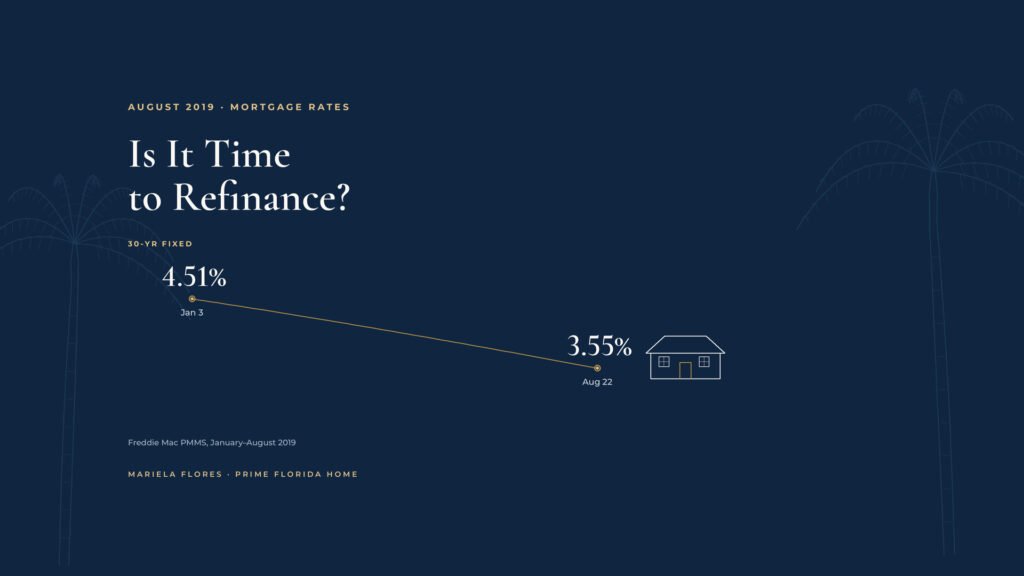
Mortgage rates had already been falling for months. According to Freddie Mac’s weekly survey:
- January 3, 2019: the average 30-year fixed rate was 4.51 percent.
- August 1: 3.75 percent.
- August 22: 3.55 percent, the lowest level since November 2016. The 15-year fixed rate averaged 3.03 percent.
Freddie Mac’s chief economist, Sam Khater, said refinances “surged to their highest share in three and a half years,” and that households that refinanced in the second quarter of 2019 will save an average of $1,700 a year, or about $140 a month.
The Fed and your mortgage are related, but not the same
The federal funds rate is a short-term rate between banks. A 30-year mortgage rate is tied more closely to longer-term borrowing costs and investors’ expectations about the economy. That is why mortgage rates fell well before the Fed acted. It also means a future Fed decision will not automatically move your mortgage rate by the same amount.
A simple example
Here is an illustration, using principal and interest only on a $300,000, 30-year fixed loan:
- At 4.94 percent, Freddie Mac’s average in mid-November 2018, the payment is about $1,599.
- At 3.55 percent, this week’s average, the payment is about $1,356.
That is a difference of roughly $244 a month. Your own rate will depend on your credit, your loan amount, your home’s value, and whether you pay points, so treat this as a starting point, not a quote. Freddie Mac’s survey also reports that its averages include about half a point in fees and points.
Four questions to ask before you refinance
1. What will it cost? Refinancing has closing costs, such as lender fees, title insurance, an appraisal, and in Florida, state documentary stamp tax on the new note. Ask for a written Loan Estimate so you can compare.
2. How long until you break even? Divide the total closing costs by your monthly savings. For example, if a refinance costs $4,000 and saves $244 a month, you would break even in about 16 to 17 months. If you plan to stay longer than that, the refinance may be worth it.
3. Are you restarting the clock? If you are seven years into a 30-year loan, a new 30-year loan stretches your payments out again. A 15-year or 20-year loan may cost a little more each month but save interest over time. Ask your lender to show you both.
4. Does your home’s value support it? Your loan-to-value ratio affects your rate and whether you need mortgage insurance. Miami-Dade single-family median prices have risen year over year for more than seven years, according to the MIAMI Association of REALTORS®, which may help, but an appraisal will confirm your home’s value.
Other reasons people refinance
Lower payments are not the only reason. Some homeowners refinance to move from an adjustable-rate loan to a fixed rate before an adjustment, to remove FHA mortgage insurance by moving to a conventional loan if they qualify, or to take a shorter term. Each option has tradeoffs, so compare the full cost, not just the rate.
For buyers, too
Lower rates also help buyers. A lower rate can mean a lower monthly payment on the same price, or more room in your budget. If you have been waiting on the sidelines, this is a good time to get pre-approved and see where you stand.
A calm next step
Rates change every week, and no one can promise where they will go next. The best approach is to know your numbers. Gather your current mortgage statement, talk with a trusted lender or two, and compare the Loan Estimates. If you are thinking about selling instead, or buying your next home, I am happy to share what homes like yours are selling for, with no pressure.
You can reach me at (305) 409-2815 or mflores@primefloridahome.com.
Warmly,
Mariela
Restored to our archive in 2026, reflecting the market as of August 2019