
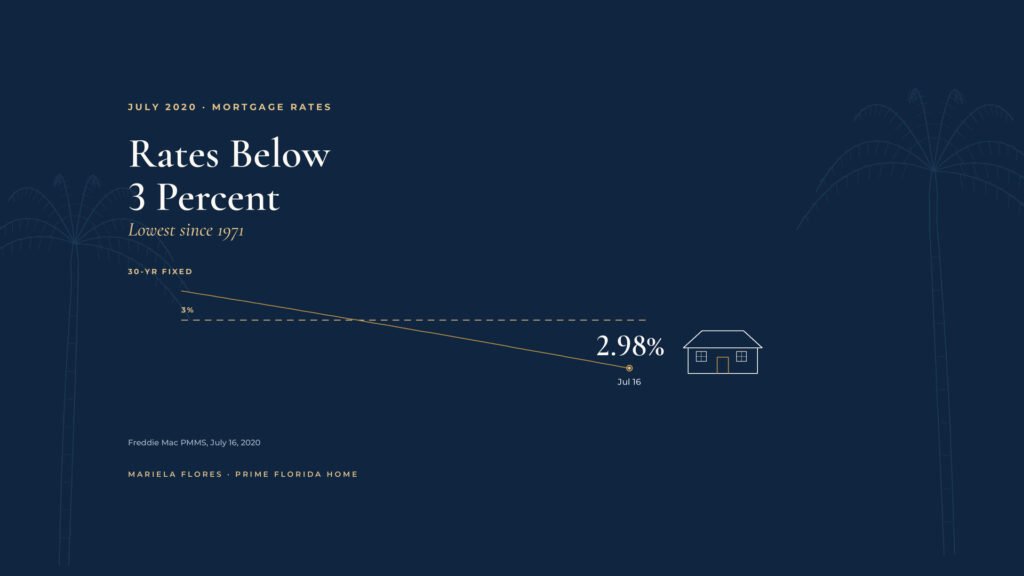
Last week, something happened that had never happened before. Freddie Mac reported that the average 30-year fixed mortgage rate fell below 3 percent for the first time in the history of its survey, which goes back to 1971. If you have been thinking about buying a home in Miami-Dade, you are probably wondering what this means for you. Here is a calm look at the opportunity, the catches, and how to prepare.
The numbers
According to Freddie Mac’s weekly survey:
- July 16, 2020: the 30-year fixed rate averaged 2.98 percent, with an average of 0.7 point. A year earlier, it was 3.81 percent.
- July 23: 3.01 percent.
- 15-year fixed: 2.48 percent on July 16.
Freddie Mac’s chief economist, Sam Khater, said the drop “has led to increased homebuyer demand,” and also noted that rising virus cases had caused the economic recovery to stagnate.
The background matters. On March 15, the Federal Reserve lowered its target range for the federal funds rate to 0 to 1/4 percent and said it would increase its holdings of Treasury and agency mortgage-backed securities. Agency mortgage-backed securities help fund many of the home loans made in the U.S.
What a lower rate does for your budget
Here is an example using principal and interest only on a $300,000, 30-year fixed loan:
- At 3.81 percent (a year ago): about $1,400 a month.
- At 2.98 percent (July 16): about $1,262 a month.
That is about $138 a month, or more than $1,600 a year. Looked at another way, the same monthly payment can support a somewhat larger loan. But please do not let a low rate push your budget beyond what feels comfortable. Taxes, insurance, and association fees are part of your real monthly cost, and in South Florida, insurance deserves careful attention.
The catch: loans are harder to get
Low rates are only half the story. The Mortgage Bankers Association reported on July 9 that its Mortgage Credit Availability Index fell 3.3 percent in June to its lowest level since April 2014. The MBA said credit supply had fallen more than 30 percent since February, with an 18 percent drop in government loan availability and a 57 percent drop in jumbo loan availability. A lower index means stricter lending standards. The MBA said investors had become less willing to buy jumbo loans and loans to borrowers with lower credit scores.
What that means for you:
- Get pre-approved, not just pre-qualified. A full review now avoids surprises later.
- Be ready to document your income again close to closing. Lenders may re-verify employment shortly before you close.
- Avoid new debt and large unexplained deposits while you are buying.
- If you need a jumbo loan, talk with several lenders, since requirements vary.
Remember that Freddie Mac’s weekly rate is an average for borrowers with strong credit. Your rate will depend on your credit, down payment, loan type, and points.
What is happening in our market
The MIAMI Association of REALTORS® reported on July 22 that buyers are active again:
- Pending sales, an early signal of future closings, rose 33.8 percent from a year earlier for single-family homes, to 1,820, and 12.9 percent for condos, to 1,504.
- Prices: the single-family median rose 5 percent to $388,500; the condo median rose 4.8 percent to $262,000.
- Closed sales were still down, 11.8 percent for single-family homes and 33.1 percent for condos, reflecting contracts delayed in the spring.
- Supply is tight for houses: single-family inventory fell 25.6 percent to 4,929 listings, a 4.8-month supply. Condos had a 14-month supply.
The Association also noted that some closings are taking longer, because social distancing can delay inspections, appraisals, and walk-throughs.
Single-family homes versus condos
These numbers point to two different markets. For single-family homes, buyers face less choice and more competition, so preparation matters. For condos, buyers have more choice and more room to negotiate, though condo financing has its own rules. As of July, the Association reported that only 13 of 9,307 condo buildings in Miami-Dade and Broward were FHA-approved.
A buyer’s checklist for this summer
- Talk with a lender first and ask what credit score, down payment, and documents they require today.
- Set your budget with all costs included, including insurance and association fees.
- Get insurance quotes early, before your inspection period ends.
- Use virtual tours to narrow your list, then plan careful, limited in-person visits that follow the public health guidance in effect.
- Allow time in your contract for appraisals and inspections.
- Consider a rate lock once you are under contract, and ask how long it lasts.
Should you wait for rates to fall further?
No one knows where rates will go next. Trying to time the bottom can mean missing the right home. If you find a home you love at a payment you are comfortable with, that matters more than a few hundredths of a percent.
A calm next step
If you would like to talk through your budget or what is selling in the areas you are considering, I am happy to help, by phone, video, or in person with care, and with no pressure.
You can reach me at (305) 409-2815 or mflores@primefloridahome.com.
Warmly,
Mariela
Restored to our archive in 2026, reflecting the market as of July 2020