
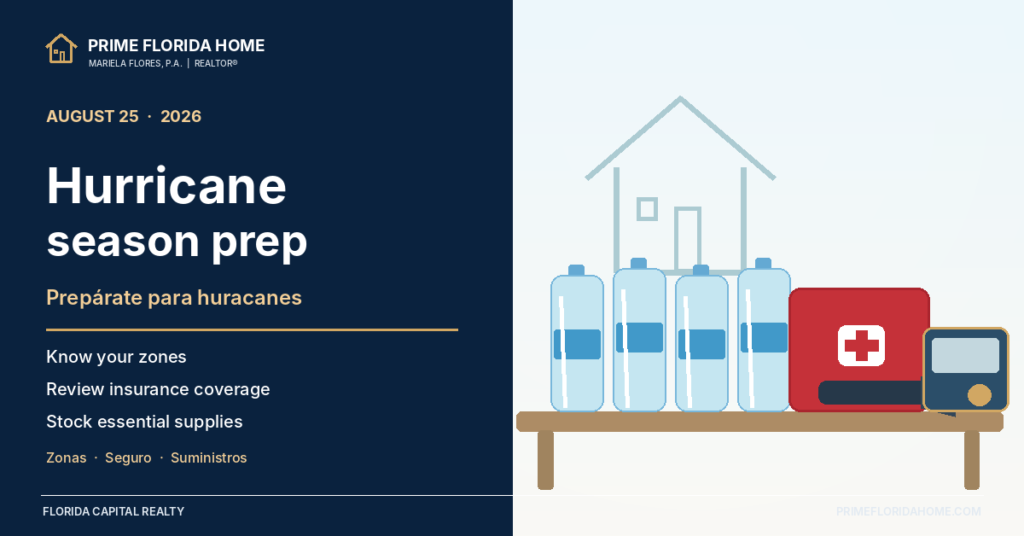
Atlantic hurricane season runs from June 1 through November 30, and NOAA says the usual peak approaches in early September. This is a practical hurricane season prep guide for Miami-Dade homeowners, buyers, and sellers, not a forecast of where a storm will come ashore. NOAA’s seasonal outlook is not a landfall forecast. A quieter outlook is also not a reason to wait.
I have been in the Miami market since 1995, and the most useful preparation I see is the quiet kind: knowing your zone, reading your policy, and restocking a few supplies before you need them.
Hurricane season prep for Miami-Dade homeowners, before the peak
On August 6, 2026, NOAA kept its prediction of a below-normal Atlantic season. The update calls for 7 to 13 named storms, 2 to 6 hurricanes, and 0 to 2 major hurricanes for the whole season, including Arthur and Bertha, which had already formed. NOAA put the chance of a below-normal season at 75 percent, near normal at 20 percent, and above normal at 5 percent. In a typical season, the agency says, there are 14 named storms, 7 hurricanes, and 3 major hurricanes.
NOAA pointed to a strengthening El Niño and higher wind shear as reasons activity may stay lower. As of that August 6 update, there had been two named tropical storms and no hurricanes. The agency also noted that inland rain can still do damage even when a storm never reaches hurricane strength. You can read the update on NOAA’s site and follow live storms at hurricanes.gov.
Know your surge zone, and do not confuse it with your flood zone
Miami-Dade uses Storm Surge Planning Zones A to E. Zone A is at the greatest risk for Category 1 storms and higher. Zone E is at risk from Category 5 storms. Evacuation is ordered by zone, or by part of a zone, based on the storm’s track and the projected surge, not on the category alone. These planning zones deal with storm surge, not with the flood zone on an insurance or survey map. You still need to decide whether your home is a safe place to stay during a storm.
Look up an address with the county’s Know Your Zone tools and the Ready MDC app, or start at the county hurricane hub and the storm surge page. Sign up for Miami-Dade Alerts so official notices come to you. The county’s own disclaimer is important: residents of mobile homes, and people who depend on electrically powered life-sustaining equipment, should evacuate when any hurricane evacuation order is issued, regardless of zone.
If you live in northern Tamiami, including zip code 33182, the lookup works the same way as anywhere else in the county. My Tamiami 33182 guide can help with area basics, but your zone is tied to the specific address, not to the zip code as a whole.
Review your hurricane deductible and your flood coverage
If your homeowners policy has wind or hurricane coverage, it may also have a separate hurricane deductible. That amount is often shown as a percentage of the dwelling limit and also as a dollar amount. Florida law is specific about when it applies. After the National Hurricane Center has declared a hurricane, the deductible can apply from the time a hurricane warning is issued for any part of Florida until 72 hours after the last hurricane watch or warning ends. The Florida Department of Financial Services explains this in Florida’s Hurricane Deductible, citing sections 627.4025 and 627.701 of the Florida Statutes.
Companies must offer certain deductible options, generally $500, 2 percent, 5 percent, or 10 percent, with exceptions that depend on the dwelling limit. The hurricane deductible is generally annual if you stay with the same insurer or group. Flood is not a standard homeowners peril, so confirm flood coverage separately. This is a good week to pull out the declarations page, take photos of your home and its contents, and keep policy papers in a waterproof place. For questions about what your policy covers, use the Department of Financial Services consumer resources or speak with your insurance agent. I can help you think through how insurance comes up in a sale or a purchase, but I am not your insurance adviser.
Tax-free supplies, and what to stock
There is no 2026 disaster-preparedness sales tax holiday. Many of the items that used to appear on those short holiday lists have been exempt from Florida sales tax year-round since August 1, 2025, under the Department of Revenue’s TIP 25A01-05. The publication lists size limits, not price caps. Examples include AA, AAA, C, D, 6-volt, and 9-volt batteries; portable generators of 10,000 running watts or less; waterproof tarps and sheeting of 1,000 square feet or less; ground anchors and tie-down kits; portable gas or diesel cans of 5 gallons or less; smoke detectors, carbon monoxide alarms, and fire extinguishers; and life jackets, sunscreen, and insect repellent.
Effective July 1, 2026, portable propane tanks of 20 pounds or less were added to the fuel-can exemption, as explained in TIP 26A01-05. Some items from older holiday lists, such as flashlights or coolers, are not on the permanent exemption list.
For quantities, use official checklists rather than a made-up kit cost. The Florida Division of Emergency Management Disaster Supply Kit Checklist calls for 1 gallon of water per person per day for 7 days, and at least a two-week supply of medication. Miami-Dade’s official readiness guide says to plan for at least one gallon of water per person per day for three to seven days, and food for at least three to seven days. Keep the county guide, 311, and Ready MDC handy.
If you are listing or closing during the season
Keep important documents together, know how your association or building communicates, and ask about flood history and insurance early in a transaction. A delayed inspection or a harder-to-schedule closing can happen in any month, and a little extra time in the contract can help. If you want to talk through a timeline, I am here.
The bottom line
NOAA still sees a below-normal season, but the peak is near, and preparation is the same either way: know your zone, read your deductible, and restock supplies you can buy tax-free all year. If you have questions about buying or selling during this stretch of the season, we can go over them at your pace, with no pressure.
References
- NOAA, NOAA maintains prediction for below-normal Atlantic hurricane season, August 6, 2026
- National Hurricane Center: hurricanes.gov
- Miami-Dade County, storm surge planning zones, hurricane hub, and official readiness guide
- Florida Department of Financial Services, Florida’s Hurricane Deductible
- Florida Department of Revenue, TIP 25A01-05 and TIP 26A01-05
- Florida Division of Emergency Management, Disaster Supply Kit Checklist
You can reach me at (305) 409-2815 or mflores@primefloridahome.com. Mariela Flores, P.A., Florida Capital Realty.
Warmly,
Mariela
Restored to our archive in 2026, reflecting the market as of August 2026